


Introducing Prophet AI Detection Engineer: Find Every Coverage Gap and Close It

When we built the Prophet AI SOC Analyst, we set out to take the alert investigation burden off security teams, looking at every alert, chasing down the evidence, and reaching a determination the way a good analyst would. It has worked well enough that a different constraint became the visible one: do we have the right detections in place and are they working as expected?
We were dependent on the quality of the upstream detection. Sometimes an alert only brushes the edge of the real activity, and enrichment and pivoting carry the investigation the rest of the way. But if a detection wasn’t present or never fired, there was nothing to investigate. The threat simply passed through.
That is the problem Prophet AI Detection Engineer solves. Prophet AI Detection Engineer builds a live MITRE ATT&CK coverage map from your own detections and investigations, identifies coverage gaps, then authors, tunes, and backtests them. These detections arrive as reviewable, version-controlled changes that your team approves and are deployed on the SIEM you already run. You get greater value from your existing security stack, no rip and replace needed.
How detections drive risk
Threat detection, investigation, and response only reduces risk if the whole chain holds, and the chain starts with detection. For detection to do its job, three things have to be true:
- You have to detect some activity of the threat. A gap in detection coverage lets a threat walk in unseen. Nothing downstream can save you from a detection that doesn't exist, short of threat hunting, which we cover below.
- You have to detect it early. The sooner a threat surfaces, the less dwell time an attacker has and the cheaper the response. Late detection means an expensive response.
- You have to detect it efficiently. Every unnecessary alert costs something, and even with automated investigation it costs real money — you are spending compute to handle alerts that a better rule would have suppressed or never fired at all.
Miss on the first and you carry silent risk. Miss on the second and you're reacting too late. Miss on the third and you're paying to investigate noise. Effective detection means getting all three right, accepting that 'right' never lasts, & therefore continuously monitoring, as your environment and threats change.
Most teams don't have a systematic way to know where they stand on any of the three. Coverage dashboards report which rules are switched on, but often fail to indicate if those rules fire, fire well, or ever produce a real investigation. The dashboard stays green while the blind spot stays open.
A coverage map built from your own investigations
Prophet AI Detection Engineer starts somewhere no rule-inventory tool can: your investigations.
Because the Prophet AI SOC Analyst already investigates your alerts and reaches determinations, we know which alerts are genuinely low-value, where coverage is real versus superficial, and which techniques your SOC is actually seeing. From that ground truth, Prophet AI Detection Engineer builds a live MITRE ATT&CK coverage map with three honest states:
- Observed: Detections that produce real signal and real investigations.
- Covered: Detections that are in place but haven't produced investigations.
- Uncovered: Techniques where nothing is watching at all.
This is the difference between a list of detections you own and a map of the coverage you actually have.
Closing the gaps, and cutting the noise
A map is only useful if it drives action. Prophet AI Detection Engineer turns the coverage picture into a stack-ranked list of the highest-impact moves, and then does the work:
- Authors net-new detections for the gaps that matter, written in your stack's native dialect, grounded against your connected data, and backtested against your own history before they go live.
- Tunes and suppresses the rules already running, distilling noise-reduction opportunities from your real investigations so you reclaim the hours and the cost lost to unnecessary alerts.
- Builds a prioritized hunt backlog aimed at the thinnest parts of your coverage, which run on schedule or continuously, and turns the strongest findings into lasting detections.
- Flags telemetry and data-quality gaps that would otherwise read as silence on the map, surfaced the way an analyst finds them, when investigations repeatedly hit missing data.
These actions map onto the risk equation directly. Closing gaps improves coverage, so more of what matters gets detected and investigated. Tuning noise improves efficiency, so detection and response becomes faster and less expensive. Hunting finds the latent threats that have not triggered any detection. Flagging telemetry and data issues means a detection failure caused by missing data gets fixed rather than mistaken for quiet. Together they mean the organization detects the threats that can actually target it, and spends its detection effort where it counts.
{{ebook-cta}}
Preview, backtest, and apply, at the pace you choose
Detection engineering has historically been artisanal: manual, untracked, and hard to trust. We built Prophet AI Detection Engineer to be the opposite.
Every recommendation is tested against your own recent history, in a process we call backtesting, so you see the impact before anything takes effect, with no leaps of faith. Every authored detection arrives as a reviewable, version-controlled change with its rationale, the investigation evidence behind it, the backtest results, and a confidence assessment attached.
And how much of that activity runs on its own is your call. AI Detection Engineer defaults to suggest-and-inform: it does the analysis and drafts the change, your team provides the judgment and the approval. As the track record earns it, you can turn autonomy up per category of work, or leave everything held for sign-off. You are never asked to trust a black box.
Because the agents work continuously around the clock drafting and testing (eventually discarding candidates that miss the quality bar), security teams can make their decisions from a short list of vetted recommendations, not a pile of raw ideas.
Prophet AI Detection Engineer works on the stack you already run
We wanted to improve detection without building another system to collect raw telemetry and apply detection rules. Prophet AI Detection Engineer works with the SIEMs you already have, starting with Splunk, Sumo Logic, and Microsoft Sentinel, with more to follow. Detections are delivered in a portable, vendor-neutral form into your own review process. No rip and replace,and no lock-in. If you ever change SIEMs, the program and its history come with you.
Better detection, better investigation, less risk
This is what completes the loop for us. The Prophet AI SOC Analyst handles today's alerts; Prophet AI Detection Engineer makes sure tomorrow's queue is smaller, sharper, and covers the threats that matter; Prophet AI Threat Hunter hunts for emerging threats and threats missed by your detections. Every investigation makes detection better, and better detection makes every future investigation more valuable and less noisy.
For teams that have never had a dedicated detection engineer, this is the program they never had the headcount to run. For teams that do, it's the teammate that does the continuous analysis, drafting, and testing so their people can focus on judgment.
Detection engineering has been the work that everyone wants to do, but never happens. We're turning it into a program with proof.
Prophet AI Detection Engineer is available to Prophet AI SOC Analyst customers. To see a coverage map of your own environment and the highest-impact moves waiting in it, request a demo.

Product Updates
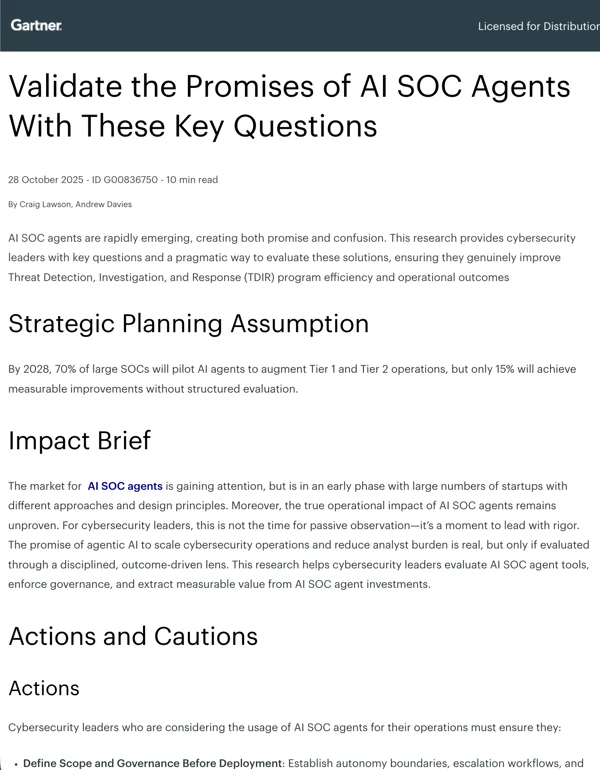
Not Every AI SOC Agent Delivers on the Promise
Leverage Gartner's list of specific questions to ask vendors before committing to a solution

Daniel Martin is a product leader at Prophet Security with over a decade of experience in cybersecurity product management. Before joining Prophet, he spent five years at Rapid7 leading product for InsightIDR's SIEM, XDR, and MDR capabilities. He's focused on building products that help security teams detect and respond to threats faster.