


Emerging Threat Response Shouldn't Start With a 6 A.M. Scramble
The next critical threat will arrive on its own schedule, probably sometime in the middle of the night.
By morning, the links start piling up. Two vendor advisories, a CISA alert and three research posts with different indicator lists. By 6 a.m. someone has pasted the headline into Slack or Teams and asked the question that follows every serious disclosure: Are we exposed?
The unfortunate soul in the security operations center that wakes up first or gets called that morning now realizes this will consume their morning, dutifully shotguns a Red Bull and gets started. It's time for a threat hunt.
They read the reports, pull out the indicators, remove duplicates, check which products the company runs, and figure out where each artifact might appear.
- Domains and IP addresses go into network searches.
- File hashes need endpoint data.
- An attacker-controlled account may appear in identity logs, email, or SaaS audit events.
- A compromised package version requires visibility into what developers and build systems actually installed or at least some solid hashes to look at endpoint data.
Threat intelligence rarely arrives as a complete, authoritative answer.
{{ebook-cta}}
A 2026 preprint analyzing 16,096 public threat-intelligence reports found that, for a typical threat actor among the 100 most frequently reported, even the source with the most information covered less than 25% of what researchers found across all sources. The campaign picture is scattered across sources, leaving analysts to assemble it before the hunt can begin.
One advisory lists three IP addresses. A research post adds two hashes. Another source gives the same campaign a different name, proving once again that naming things remains one of computer science's hardest problems. Some indicators come with useful context. Others appear in a table with no explanation of when they were observed or why they matter.
The analyst compares reports, follows citations, checks timestamps, removes duplicates, and decides what deserves to be searched.
Only then does the hunt begin and by that point, the intelligence may have changed. A researcher publishes another IP address. A new hash appears. The affected package list grows. The campaign gains a second stage that nobody understood the night before. Indicators age like milk, not wine. The campaign keeps moving but the hunt isn't moving at the same pace.
So the searches run again.
This is how most organizations handle emerging threats: one skilled analyst, several consoles (or sometimes a good SIEM setup and many queries), too many browser tabs, and a clock that started before anyone joined the call. The workflow wastes their time.
A 2024 USENIX study based on interviews with 22 threat hunters by Badva et al. found that large volumes of data make querying difficult and time-consuming. As one participant put it, "You end up with loads of results that are useless … It's hard to filter out new threats. It's very challenging and it takes time to adjust the query to get the right data."
Security teams have built capable fire departments. When they find smoke, experienced people know how to investigate it, contain it, and make decisions under pressure. Emerging-threat response when something hits headlines still asks them to find the location of the fire after 911 dispatch has told them to suit up.
Research should begin when a critical threat appears. Known indicators should run against the security data already available. When the intelligence changes, the hunts should run again. Analysts should open the investigation with evidence already taking shape, and ideally something ready for their judgment. Threat hunting is supposed to apply security judgment to an important security question. Too often, we spend the first part of our day (or week) discovering data and writing plumbing.
Introducing the Prophet AI Threat Researcher for Emerging Threats
Today, Prophet AI Threat Researcher and Emerging Threats are generally available in Prophet AI Threat Hunter. This collaboration between Prophet AI agents turns emerging intelligence into hunts that keep pace as threats change.
Prophet AI Threat Researcher is among the newest agents within the platform that scours OSINT for emerging vulnerabilities, campaigns, and attacker activity relevant to your organization. It reconciles the available reporting into sourced research, preserves the context behind each tactical and behavioral indicator, and collaborates with Reactive Hunting agents within Prophet AI Threat Hunter to build and automatically execute a hunting plan for your environment.
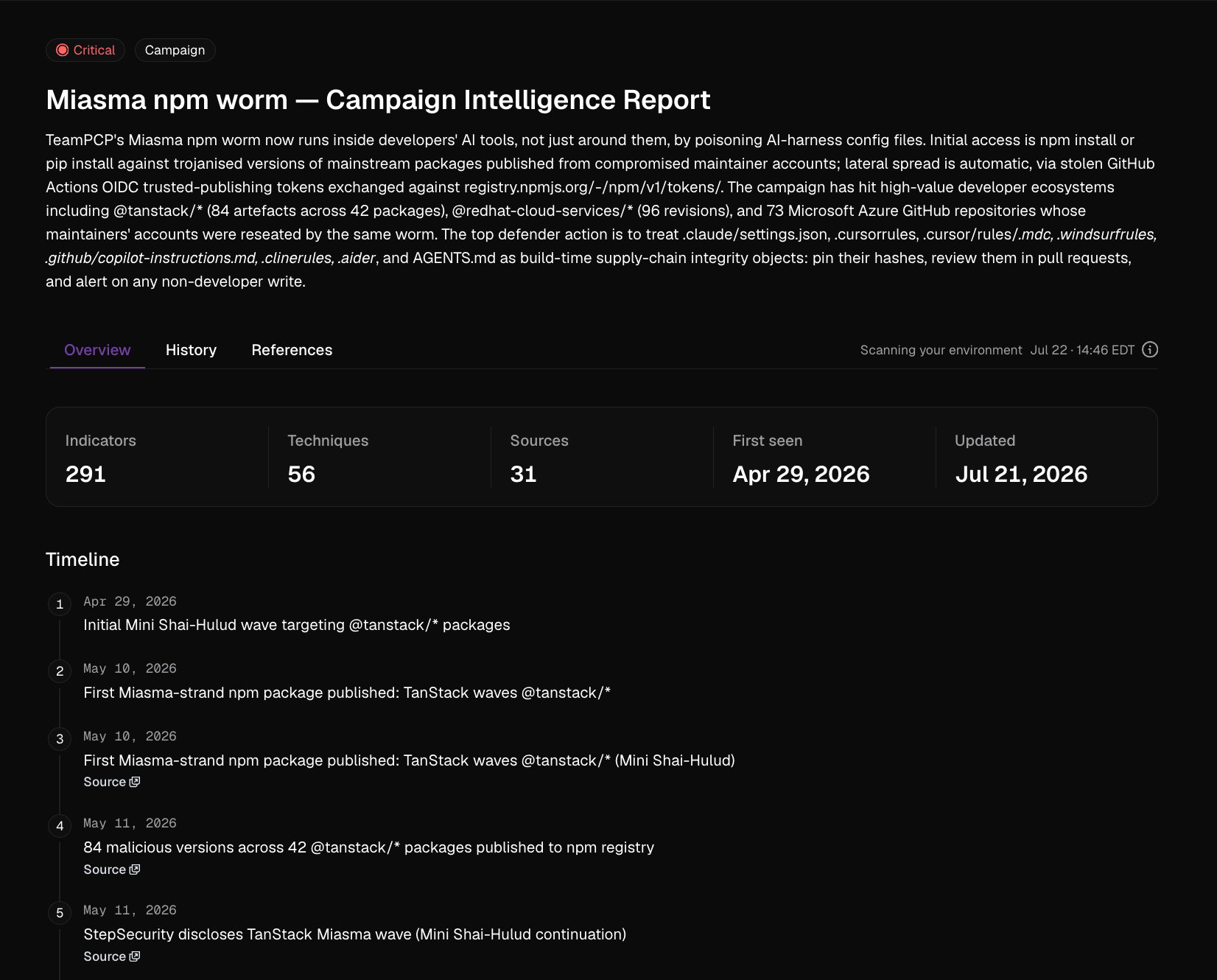
Developing campaign? Not a problem. Threat Researcher is constantly evaluating for new intelligence to expand the threat hunt automatically with the most available insight. No more spamming the refresh button to stay informed.
Together, as an agent team, the agents handle the intel research, environmental context, threat hunt planning, data collection orchestration, and analysis. Prophet AI Threat Hunter then creates a report of the threat hunt, and delivers the report directly to your inbox.
Customers can choose how much approval they require before hunts run. Prophet AI can automate the research and execution, then surface the leads it finds for further investigation.
Threat hunters should spend their time determining which threats pose the greatest risk to the business, assessing exposure and potential impact, and deciding what action to take next. They should not have to act as threat intelligence collectors, data engineers, and query-language specialists before that work can begin.
Your reaction time to zero-day activity shifts from days to minutes with intel curation, analysis, reporting, and response handled by Prophet AI. In short, by the time someone asks the question, you should already have the answer
Keep the alarm. Lose the scramble.
The next critical vulnerability, ransomware campaign, or supply-chain compromise will still arrive at an inconvenient hour, and leadership will still ask whether the organization is exposed. What changes is who carries the first hour. By the time that question reaches a person, the research is current, the indicators are mapped, the hunts have already run, and the evidence is waiting in the inbox.
That is the point of the whole system: to hand the threat hunter a head start instead of a blank page. The collection, the reconciliation, the query rewriting, the re-running every time a new indicator drops, all of it happens before anyone logs on. Hunters get their attention back for the work only they can do, deciding which threats actually put the business at risk, judging real exposure, and hunting ahead of the next disclosure rather than chasing the last one.
Prophet AI Threat Researcher and Emerging Threats are generally available in Prophet AI Threat Hunter today. Existing customers can turn on Emerging Threats right now. Security teams evaluating Prophet AI can request a demo and see it against a live threat.

Product Updates
Prophet Security Quarterly Threat Report
The attack patterns seen most across customer environments, and why some of those attacks succeeded where others were blocked.


Jamie is a product manager at Prophet Security and a recovering security engineer who switched to product because being part of a P&L is more fun than midnight changes and incident response. Before Prophet, he spent nearly four years as Founding Product Manager at Endor Labs and held product roles at Red Hat and StackRox.