


What Is an AI Detection Engineer? A Practitioner's Guide for 2026
.avif)
Detection engineering is widely treated as a strategic function, yet often thinly staffed. Roughly 80% of organizations report actively investing in it, rising to 85% among large enterprises, according to State of Detection Engineering research from Anvilogic and SANS. A dedicated detection engineer is still rare outside the largest teams, so in most organizations the work falls to analysts who are pulled back into triage, and the queue wins, because unworked alerts are measured and escalated, and nobody is paged about a technique that has no detection.
The consequence is visible in what teams switch off. In Prophet's State of AI in the SOC 2026 survey of 250 security practitioners, 14% said they had turned off a detection rule because they lacked the capacity to investigate what it produced, and another 26% said they could see themselves doing it. Capacity, rather than risk, is setting coverage in roughly two of every five programs.
Detection engineering is the practice of deciding what behavior should raise an alert, expressing that as logic against the telemetry available, and maintaining it as the environment and the attacker change. It is hard for reasons that have little to do with writing rules. The craft requires attacker knowledge, data engineering, rule logic, and fluency in whichever query dialect the SIEM speaks, usually combined in one person, which is why the role is hard to hire for and harder to backfill. Good looks like four things at once: a coverage picture the team trusts, changes tested before they apply, a documented rationale behind every rule that survives its author leaving, and a false-positive rate low enough that analysts still read the alerts. Almost no team has all four, and the ones that do usually bought them with headcount.
What an AI Detection Engineer Is
An AI detection engineer is a system of AI agents that runs the detection engineering program continuously: it maps real coverage from investigation evidence, authors detections in the native dialect of the stack you already run, backtests every proposed change against your own history before it applies, and delivers each change as a reviewable, version-controlled item your team approves.
An AI Detection Engineer gets its input from an AI SOC Analyst (you can read more on that here.) A tool that reads your rule inventory can tell you which detections are enabled. A system that has investigated the alerts those detections produced can tell you something more useful: which rules have ever fired, which fired and never resolved to anything real, and which techniques you have never observed at all. That produces three coverage states rather than two. What you can detect, what has gone quiet, and what is genuinely dark are different conditions with different remedies, and a dashboard counting enabled rules reports all three as green.
Another thing to remember is detection changes are production changes. An AI detection engineer will write rules into a SIEM only after testing them against real history, and human sign-off, ensuring that the testing and review steps that make the change safe are not skipped.
What an AI Detection Engineer Does in Practice
The work divides into five kinds, and a serious implementation should do all of them.
- Mapping real coverage. Building and maintaining a live map against a framework such as MITRE ATT&CK from investigation and hunt evidence rather than from a rule-to-technique spreadsheet. Point-in-time assessments go stale within weeks; this one updates as investigations complete.
- Directing hunts at the thinnest coverage. An uncovered technique raises a question no detection can answer, which is whether anything has already happened there. Ranking the dark and quiet parts of the map into a hunt backlog puts that question in front of a hunting program, and the leads that come back are the evidence new detections get written from.
- Authoring new detections. Reviewing confirmed-malicious investigations, validated hunt findings, and near misses where a single detection was the last line of defense, then drafting the rule against your connected data, checking it against existing coverage so duplicates are not introduced, and backtesting it before it is offered for review.
- Tuning and suppressing. Analyzing the rules already running against what investigations concluded about their output, then proposing tuning and suppressions for the noise that repeatedly resolves benign, with the impact of each change tested against recent history first.
- Finding telemetry gaps. Flagging the data sources that repeatedly fail investigations, with the affected investigations attached as evidence. A source that stopped logging reads as quiet coverage until something names it, and a connector checklist has no way to tell a healthy source from a silent one.
{{ebook-cta}}
Benefits of an AI Detection Engineer
Writing detections faster is worth little on its own. The argument for the category is about what changes for the people accountable for coverage.
Closing coverage gaps reduces risk directly
Detections exist to catch attackers, so a technique nobody covers is an open path into the environment with nothing watching it. Continuous gap analysis shortens how long those paths stay open: the gap is found, a detection is drafted and backtested against your own history, and the change reaches review without waiting for an annual assessment to surface it.
You find out which of your detections have never caught anything
Almost no team has this view today. Building it by hand would mean tracing every rule to the alerts it fired, and every alert to its determination (true positive or false positive). The map shows three things: rules that catch real activity, rules that have been on for years and never produced a real investigation, and techniques with nothing watching them. The team gets a list of what to fix. The CISO gets a coverage number that holds up when someone asks how it was measured.
Cutting noise no longer means turning a detection off
When a team is drowning, the lever within reach is switching the rule off, which buys relief and opens a blind spot. Suppression narrows what a rule reports without removing the rule, so alert volume falls and the technique stays covered.
The work gets done without competing for triage hours
Agents draft, test, and discard candidates continuously in the background, so the review queue contains vetted proposals rather than raw ideas. That moves the constraint from producing candidates to reviewing them, and reviewing a tested proposal takes minutes where producing one takes hours.
A rule's reasoning stays when its author leaves
Tribal knowledge is the standing failure mode of detection programs: when the person who wrote the rule leaves, the reason it exists leaves too. Changes that carry their rationale, supporting evidence, and backtest results are readable by whoever inherits them.
Nobody has to write the improvement report
Metrics and documentation rank among detection engineers' least favorite work, which is why programs that improve often cannot prove it. A running record of what was recommended, applied, and reverted produces that evidence as a byproduct.
Final Thoughts
Detection coverage sets the ceiling on everything downstream. An investigation can only begin with an alert that fired, and a response can only begin with an investigation. A technique with no detection caps what the rest of the program can achieve, however well it runs. The alerts that do fire still need investigating, and someone still has to look where nothing fired at all. That is what threat hunting does. Either result becomes permanent coverage only when a detection is written for it.
Nothing in this description is unique to one vendor, and the same questions apply to Prophet Security. Prophet AI Detection Engineer builds its coverage map from investigations the platform has already run. It backtests every authored detection and tuning change against your own history before it applies, and holds each change at whatever level of review your team sets. To see what that map looks like against your own environment, request a demo.

Insights
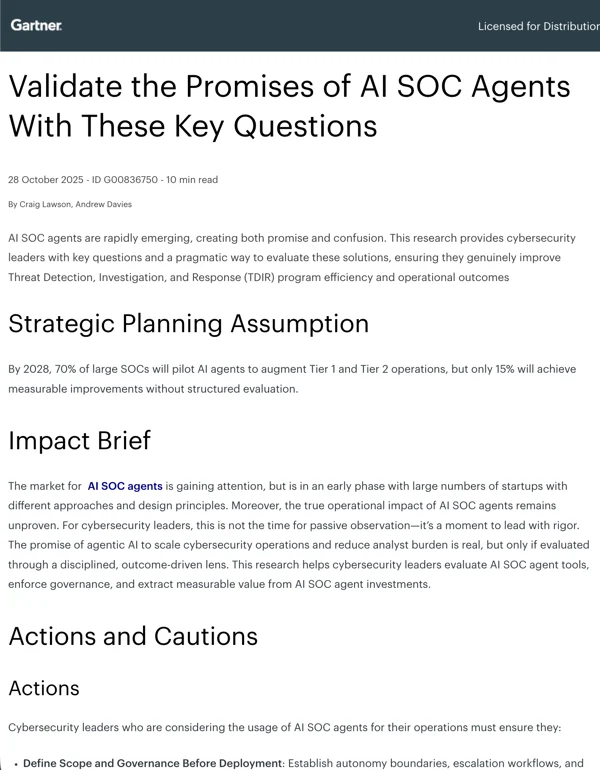
Not Every AI SOC Agent Delivers on the Promise
Leverage Gartner's list of specific questions to ask vendors before committing to a solution

As the Director of Product Marketing at Prophet Security, Ajmal drives marketing and growth strategies and helps security professionals see how AI is transforming security operations.