


AI SOC Pricing Models Compared: Per-Alert, Per-Endpoint, Per-Data, and Flat
AI SOC pricing is not standardized across vendors. Some platforms bill per alert investigated, some per endpoint monitored, some by the volume of data ingested, and some charge a flat platform fee. Each structure meters a different variable, so two vendors can quote comparable headline rates and still produce very different annual totals for the same environment, and the structure usually affects the total more than the rate does.
Pricing is also one of the questions buyers raise most often during evaluations, because the model decides who absorbs the cost when alert volume rises or a noisy detection floods the queue. This piece covers the four main AI SOC pricing models, what drives the bill under each, the costs that sit outside the published rate, and how to test pricing in a proof of value.
Why AI SOC pricing is hard to compare
The deeper reason these structures diverge is the investigation gap. A large SOC generates hundreds to thousands of alerts a day, while a human analyst can fully investigate roughly twenty to thirty. An AI SOC analyst is built to close that gap by investigating every alert at a consistent depth, which changes the unit economics of the program. A price should therefore be judged against the volume and footprint a team actually runs, not the smaller dataset used in a demo.
{{ebook-cta}}
The four AI SOC pricing models
Most offerings use one of four structures, with two newer variants appearing at the edges.
- Per-alert, or per-investigation. Billing follows the number of alerts the platform investigates, often sold as an investigation capacity comparable to a tier-1 analyst's output. It ties cost to completed work and rewards tuning, since a suppressed false positive is an alert that no longer incurs cost. The main risk is the rate charged when volume runs past the committed capacity, so those terms deserve as much attention as the base figure.
- Per-endpoint. Billing scales with the number of endpoints or assets monitored, a model inherited from EDR and MDR. It is predictable, forecasts cleanly as headcount and devices grow, and decouples cost from alert noise. The trade-off is fit: a large fleet of low-risk endpoints can cost more than its risk warrants, while a small but noisy environment can look cheap on paper.
- Per-data. Billing follows the volume of telemetry ingested or scanned, typically per gigabyte, a model inherited from the SIEM market. Data volume and security value correlate only loosely, so high-volume sources such as cloud flow logs or DNS can dominate the bill while contributing little to investigations. This structure favors lean, curated logging and penalizes sending everything to the platform.
- Flat platform fee. One negotiated fee, often tiered by company size, seat count, or data sources, with usage bundled in. It is the simplest to budget and to compare at renewal, and it shifts volume risk to the vendor. The trade-off is that the figure rests on assumptions about volume, so a material change in the environment can trigger a tier increase at renewal rather than a gradual overage.
Two variants are spreading at the edges. Usage or compute-based pricing tracks query and processing volume, which is the hardest of any model to forecast before real traffic runs. Outcome-based pricing ties the fee to resolved incidents or another result. Neither is standard yet, so both are worth asking about directly rather than assuming.
Which model fits your environment
The right AI SOC pricing model is usually the one whose meter tracks something the buyer both gets value of and controls. Per-investigation ties price to completed work and suits teams with stable volume and active tuning. Per-endpoint is predictable and independent of alert noise, which suits growing infrastructure, though it can overcharge a large low-risk fleet. Per-data rewards curated logging and penalizes high-volume sources. A flat fee is the simplest to budget and moves volume risk to the vendor, at the cost of some savings when noise drops. Usage- or compute-based pricing deserves extra scrutiny, since a structure that makes deeper investigation cost more can discourage the thoroughness that justified adopting an AI SOC analyst.
Hidden costs that the AI SOC pricing page omits
The metered rate is rarely the whole AI SOC cost. A few items routinely sit outside the headline figure and deserve direct questions during evaluation.
- Onboarding and integration. Investigation quality depends on deep, bidirectional integrations into the SIEM, EDR, identity, cloud, and email stack. Ask whether that work is included or billed as a service, and how long it takes to reach full depth.
- Overage and burst behavior. For per-investigation and per-data models especially, model a high-volume month rather than an average one, and get the overage rate in writing.
- Data residency. Single-tenant deployment, running the data plane in your own VPC, and zero data retention with model providers should be table stakes, not extra cost.
- Record retention. Investigation records and audit trails have to be stored somewhere; confirm what retention is included and what extending it costs.
How to test AI SOC pricing in a POV
Pricing comparison drawn from a vendor spreadsheet should be based on proof of value against real volume. Feed it the noisy sources you actually have rather than a curated slice, and track alerts per investigation by alert type, since identity, phishing, and cloud findings do not cost the same to work. The same exercise that tests investigation quality also calibrates the bill.
Keep price and value as separate questions. What a platform charges is addressed here; what it returns is the subject of the ROI of AI in the SOC and the internal business case. Once analyst time enters the calculation, a higher rate that closes the investigation gap and frees capacity for hunting can be the cheaper option.

Insights
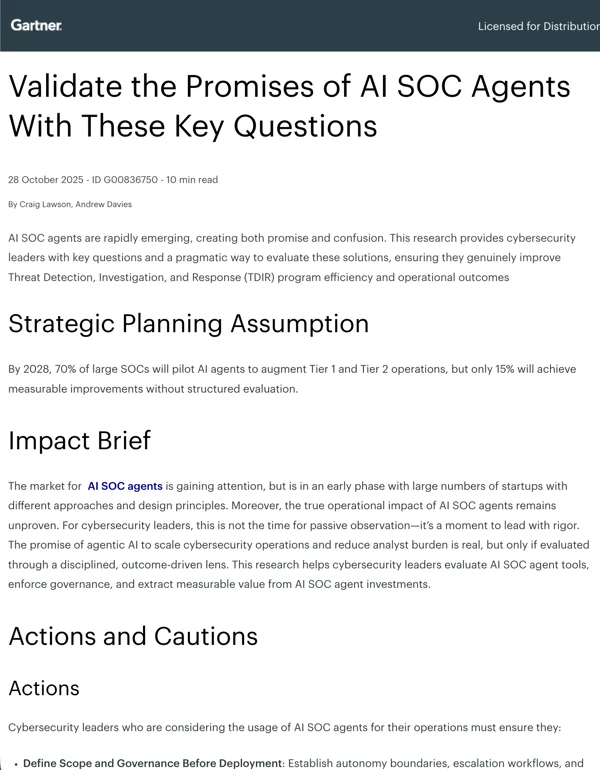
70% of SOCs will pilot AI Agents. Only 15% will see results
This Gartner research arms security operations leaders with a list of specific questions to ask vendors during evaluation

.avif)
As the Director of Product Marketing at Prophet Security, Ajmal drives marketing and growth strategies and helps security professionals see how AI is transforming security operations.