
Start your engines. Black Hat Booth #4140 has a Lambo.

.avif)
-min.webp)
It’s 1:15 AM on a Sunday. Your Lead Security Analyst's phone buzzes, jolting them awake. It’s a PagerDuty alert indicating a potential lateral movement spike. Groggy and fighting sleep inertia, they log in, stare at the bright screen, and try to piece together context from a dozen different logs.
Browse any security community forum, and you’ll see this isn't an outlier. But while the fatigue is real, the "Night Shift" dilemma serves as the perfect case study for why the traditional SOC model is undergoing a transformation with the emergence of AI SOC Agents.
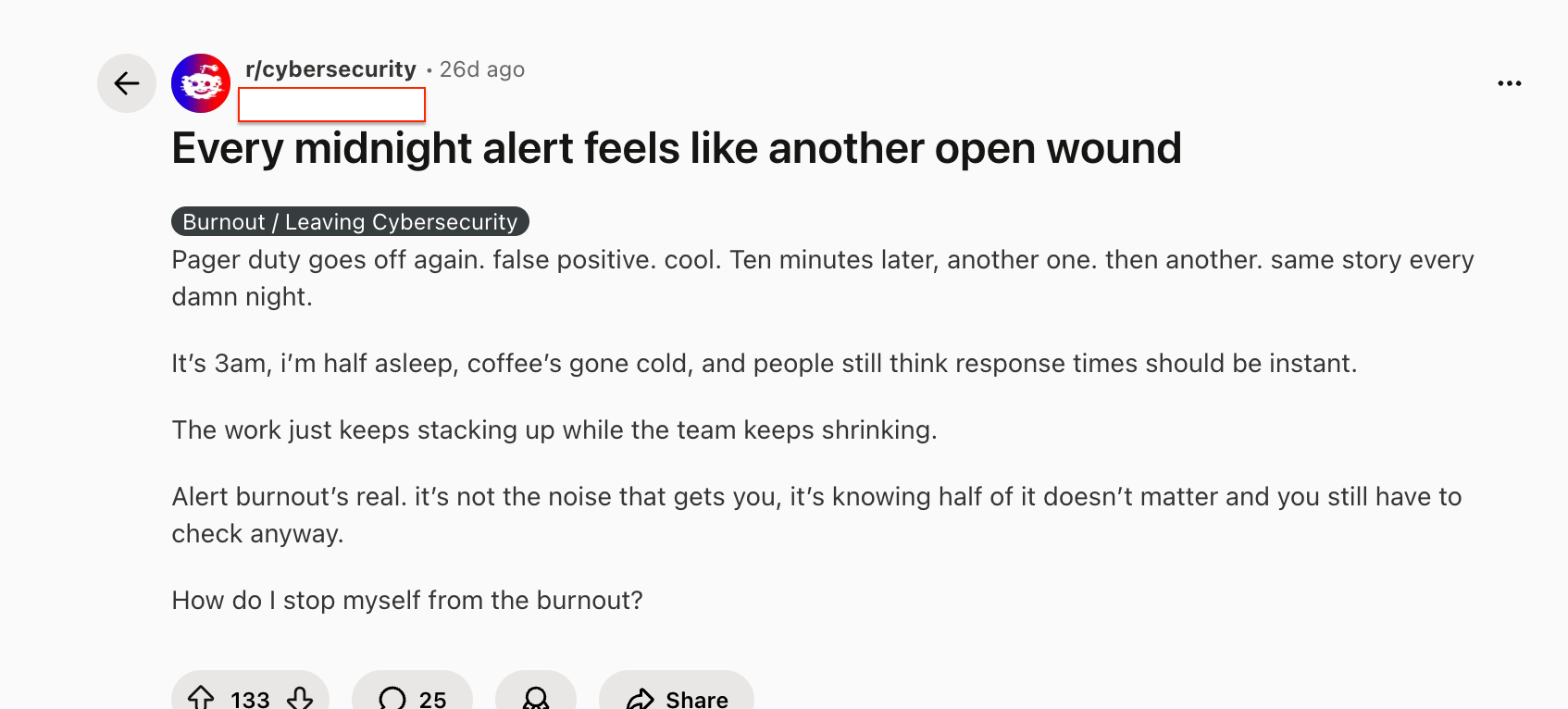
The industry has long accepted that "eyes on glass" must be maintained around the clock. However, trying to solve 24/7 coverage with human staffing alone forces organizations into two imperfect compromises:
To maintain control, many teams run a minimal crew overnight.
The most common alternative is offloading the night shift to an external provider to save internal burnout.
We are reaching a breaking point where throwing more people at the 24/7 problem is no longer sustainable. The solution isn't better coffee for the night crew; it’s changing who (or what) works the shift.
This is the specific operational gap that AI SOC Agents are built to close.
Unlike standard automation that follows rigid playbooks, AI SOC Agents use advanced reasoning to investigate alerts with the nuance of a human analyst—but without the biological constraints. It doesn't suffer from sleep inertia, it doesn't get bored staring at logs, and it operates with the same depth of context on Tuesday afternoon as it does on Saturday night.
{{ebook-cta}}
Adopting an AI SOC platform allows organizations to fundamentally restructure their security operations.
In this model, the AI SOC Agent acts as the primary Tier 1 and Tier 2 analyst during off-hours. It handles the triage, investigates alerts to determine veracity, and can even autonomously isolate compromised hosts before damage spreads.
When the human team logs on at 9 AM, they aren't greeted by an overflowing queue of raw alerts accumulated overnight. Instead, they arrive to a set of completed investigations and decision points delivered by the AI agent.
The goal of AI in the SOC is not to replace human analysts, but to liberate them from work they are biologically ill-suited for.
By offloading the nocturnal vigil to AI SOC Agents, we allow human teams to work normal hours, reducing burnout and improving retention. We ensure that when a human analyst is looking at an incident, they are rested, alert, and operating at peak cognitive capacity.
The threats never sleep. Now, thanks to AI SOC Agents, your security team finally can.
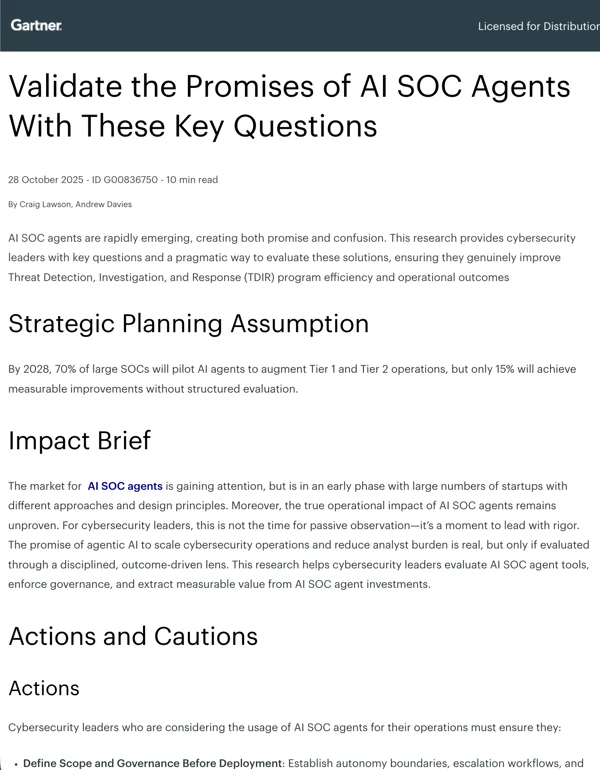
Leverage Gartner's list of specific questions to ask vendors before committing to a solution


Ajmal Kohgadai
.svg)
As the Director of Product Marketing at Prophet Security, Ajmal drives marketing and growth strategies and helps security professionals see how AI is transforming security operations.