

.png)
Top 5 AI SOC Analyst Platforms of 2026
.avif)
Every platform in security operations now ships with an agent story. Demos show an AI closing an incident end to end; contracts get signed; then the platform turns out to summarize alerts and wait for a human to ask the next question. The distance between demonstrated autonomy and shipped autonomy is the single most useful thing to evaluate in this category, and it is where the platforms below separate.
An AI SOC analyst platform is software that autonomously triages, investigates, and resolves security alerts by planning multi-step investigations, gathering evidence across the security stack, and documenting verdicts the way a trained analyst would. Five dimensions separate AI SOC analyst platforms in practice: integration coverage, investigation depth, accuracy and calibration, explainability, and how the system learns from analyst feedback.
This guide ranks the top AI SOC analyst platforms of 2026 against those dimensions. It was updated in June 2026 to reflect the current state of each platform.
How we ranked these AI SOC analyst platforms
Rankings weigh the five dimensions above, observed deployment friction, and what buyers tell us they actually evaluate. Prophet Security's State of AI in SOC research shows adoption decisions turning on trust factors, accuracy, explainability, and data handling, more than on raw feature count, and the criteria here reflect that. Prophet Security publishes this list and appears on it; the strengths and limitations for every entry, including ours, are stated so you can verify them in a proof of value rather than take our word. For a structured evaluation process, see how to evaluate AI SOC analysts. Splunk sits just outside this five: its six announced Enterprise Security agents remained largely prerelease as of June 2026, and this list weighs shipped autonomy over announced autonomy.
What changed in the AI SOC analyst platform market in 2026
Three shifts in 2026 change how the platforms should be read. First, the incumbents all shipped named agents: Microsoft widened autonomous triage from phishing into identity and cloud alerts, Palo Alto took Cortex AgentiX standalone, Cisco announced six agents for Splunk Enterprise Security at RSAC 2026, Google added threat hunting and detection engineering agents at Cloud Next, and CrowdStrike launched an entire agent-building ecosystem. The marketing gap between incumbents and AI-natives has closed; the shipping gap has not, and the honest question per vendor moved from "do you have agents" to "which of them are generally available and what do they resolve without a human."
Second, more vendors started offering Model Context Protocol support. AgentiX ships with native MCP, Google SecOps took its remote MCP server to general availability, and the practical effect is that agent interoperability across your stack is now an evaluation line item rather than a futures conversation.
Third, buyers moved from pilots to production commitments, which raises the cost of choosing on demos. Accuracy baselining against your own historical alerts, calibration behavior on ambiguous cases, and auditability of verdicts are the dimensions that separate platforms in production, and they are exactly the ones a scripted demo hides.
1. Prophet Security
Prophet AI is the agentic AI SOC platform that autonomously investigates alerts, optimizes detections, and hunts for hidden threats, accelerating detection and response across the full security operations lifecycle. Prophet AI is deployed at Fortune 500 organizations across healthcare, financial services, manufacturing, and retail. Built by security operators, its AI SOC Analyst investigates 100% of alerts with senior-analyst depth: it plans each investigation dynamically, queries SIEM, EDR, identity, cloud, and email, pivots on what it finds, and returns an evidence-backed verdict with a recommended action. Customers rate it the highest-rated AI SOC platform on Gartner Peer Insights.
Strengths:
- Comprehensive platform across the full SecOps lifecycle: Investigation, detection optimization, and threat hunting run as one integrated system, and the loop compounds: investigation verdicts tune detections, better detections cut noise, freed capacity feeds hunting, and confirmed hunts become permanent detections.
- Industry-leading depth, quality, and accuracy of investigation: Investigations are modeled after the best analysts from Red Canary, Expel, and Mandiant, documenting every query, every piece of evidence, and how each influenced the verdict in a glass-box audit trail. Quality does not degrade under volume; the thousandth alert gets the same depth as the first, and in a side-by-side at one Fortune 500 company, Prophet AI agreed with the human team on 99.8% of investigations.
- Molds to your environment: Analyst feedback is incorporated at the investigation and step level, context arrives through multi-modal ingestion, and the Guidance system encodes your custom playbooks, investigation directives, and human-in-the-loop approval gates. Customer data never trains the models, with single-tenant deployment and an in-your-VPC data plane option.
Limitations:
- Integration expansion: Support for niche or legacy on-premises custom environments is still expanding, with new integrations prioritized by customer demand.
The verdict: Where platform assistants offer tool-specific help inside their own ecosystem, Prophet Security delivers finished, auditable investigative work across your entire multi-vendor stack: a force multiplier for the team you already have.
{{ebook-cta}}
2. Microsoft (Security Copilot agents in Defender)
Microsoft has embedded autonomous agents directly into Defender. Its Phishing Triage Agent expanded in 2026 into the Security Alert Triage Agent, which autonomously classifies phishing plus a growing set of identity and cloud alerts and explains each verdict in natural-language rationale. Microsoft cites customers like St. Luke's University Health Network saving 200+ analyst hours per month, with the agent surfacing 6.5 times more malicious alerts than manual triage alone.
Strengths:
- Zero-lift deployment for Defender shops: The agents live inside the Defender console; organizations on the Microsoft security stack enable rather than integrate.
- Transparent verdicts: Classification reasoning is rendered in natural language, which eases the trust-building phase for SOC leads.
- Pace of expansion: Triage coverage has widened from phishing to identity and cloud alerts inside a year, with further agents announced at RSA 2026.
Limitations:
- Triage-stage autonomy: The agents classify and prioritize; full investigation and response remain analyst-driven or flow through separate Microsoft tooling.
- Ecosystem boundary and preview status: Coverage centers on Microsoft-generated alerts, and the identity/cloud expansion was still in preview as of mid-2026. Multi-vendor stacks see less of the value, and consumption-based pricing needs modeling.
3. CrowdStrike (Falcon Charlotte AI)
CrowdStrike has moved Charlotte AI well past the copilot stage. At RSAC 2026 it launched the AgentWorks ecosystem (a no-code platform for building custom security agents, with partners including AWS, NVIDIA, Anthropic, and OpenAI), Charlotte Agentic SOAR as the orchestration layer, and Agentic MDR through Falcon Complete.
Strengths:
- High-fidelity data: Falcon's EDR telemetry gives the agents a clean signal with fewer false positives.
- Managed service DNA: The agentic workforce is trained on the workflows of CrowdStrike's own Falcon Complete team, productizing internal expertise, now extended to machine-speed Agentic MDR.
- Extensibility: AgentWorks lets teams build and orchestrate custom agents alongside CrowdStrike's own, with workflow-level guardrails.
Limitations:
- Platform concentration: The experience is optimized for organizations standardized on Falcon modules; the orchestration value assumes CrowdStrike at the center of the stack.
- Build-it-yourself surface: The custom-agent path shifts engineering effort onto your team. Building, validating, and governing bespoke agents is a project, not a toggle.
4. Palo Alto Networks (Cortex AgentiX)
Palo Alto Networks introduced Cortex AgentiX in late 2025 as the successor to XSOAR, shipping first inside Cortex Cloud and XSIAM and rolling out to Cortex XDR and a standalone platform in early 2026. It ships prebuilt agents (threat intelligence and email investigation among the first), more than 1,000 prebuilt integrations, and native Model Context Protocol support, with the XSOAR workflow library underneath.
Strengths:
- Network effect: Organizations deep in the Palo Alto firewall, Prisma Cloud, and XSIAM ecosystem benefit from strong correlation and the largest prebuilt integration library in the category.
- Established logic: Years of XSOAR development provide workflows the agents can navigate with more flexibility than static playbooks.
- Enterprise governance: Role-based access controls, human-in-the-loop approval for impactful actions, and full action auditability suit large, compliance-heavy enterprises.
Limitations:
- Ecosystem dependency: Full value requires committing to the broader Palo Alto platform; less effective on a diverse multi-vendor stack.
- Operational complexity: The XSOAR inheritance cuts both ways. Configuring and maintaining the integration layer remains resource-intensive compared to AI-native options, and vendor-reported efficiency figures (up to 98% MTTR reduction) deserve verification against your own alerts.
5. Google Security Operations (Gemini)
Google folded Chronicle and Mandiant into Google Security Operations and is building what it calls the agentic SOC on general-purpose Gemini models rather than a dedicated security model. Its alert triage agent now runs alongside threat hunting and detection engineering agents introduced at Cloud Next 2026, with remote MCP server support generally available. Google reports the triage agent compressing a roughly 30-minute manual analysis to about a minute across more than 5 million alerts processed in the past year.
Strengths:
- Search speed: Gemini queries large telemetry volumes in seconds to surface indicators of compromise.
- Threat intelligence: Mandiant frontline intel gives the agents an edge on state-sponsored actors and novel APTs.
- Expanding agent roster: Triage, threat hunting, and detection engineering agents ship natively in the platform, with third-party context enrichment announced.
Limitations:
- Ecosystem boundary: The agents operate on telemetry consolidated into Google SecOps; autonomy is strongest for workloads already living there.
- Data residency concerns: Regulated sectors remain cautious about consolidating sensitive telemetry in a public cloud provider's AI ecosystem.
How the top AI SOC analyst platforms compare at a glance
- Prophet Security: Best for SOCs that want a force multiplier on a multi-vendor stack. Full-lifecycle agentic platform. Autonomous investigation of every alert with glass-box, auditable reasoning.
- Microsoft (Security Copilot agents): Best for Defender-standardized estates. Console-native. Autonomous alert triage with transparent rationale, expanding past phishing into identity and cloud.
- CrowdStrike (Charlotte AI): Best for Falcon platform users. Endpoint-anchored agent ecosystem. High-fidelity telemetry, Agentic SOAR orchestration, and custom-agent building.
- Palo Alto (Cortex AgentiX): Best for Palo Alto-standardized shops. Ecosystem-centric, XSOAR successor now standalone. Governance, integration breadth, and prebuilt agents.
- Google SecOps (Gemini): Best for threat hunting teams and Google-consolidated telemetry. Cloud-native. Query speed, Mandiant intel, and a growing native agent roster.
AI-native platforms worth watching
Exaforce closed a $125M Series B in May 2026 behind its Exabots agents and knowledge-graph data layer. Radiant Security's AI SOC technology was recently acquired by Cribl. Conifers builds CognitiveSOC around governed, evidence-trail investigations, with particular traction among MSSPs. Simbian fields a family of SOC, threat hunting, and pentest agents and reports auto-resolving 92% of alerts in production deployments. The evaluation dimensions in this guide apply to them unchanged, and a serious proof of value should test AI-native contenders side by side rather than assume the platform incumbents are the only field.
How to choose among AI SOC analyst platforms
Match the platform to your stack concentration and your autonomy requirement. If you are still grounding the category itself, start with the primer on what an AI SOC is before comparing vendors. If your telemetry already lives in one vendor's ecosystem, that vendor's agent will be the path of least resistance, with the trade-offs noted above. If you run a multi-vendor stack, or you need investigation-level autonomy rather than assisted triage, weight integration coverage and investigation depth most heavily, then verify accuracy claims against your own historical alerts during a proof of value. The questions in 11 questions to ask when evaluating AI SOC analysts and the process in how to run a POV for AI SOC analysts are built for exactly this comparison.
The 2026 market includes capable agentic tools from established vendors retrofitting their platforms and from AI-native entrants that started with autonomy as the design center. Retrofits carry the complexity and cost of their previous generations; AI-native platforms carry a shorter track record. The evaluation dimensions above, applied against your own alerts, settle the question better than any ranking, including this one.
If you want to see autonomous investigation against your own alert queue, request a demo of Prophet AI.
Insights
Every Alert Investigated in Minutes
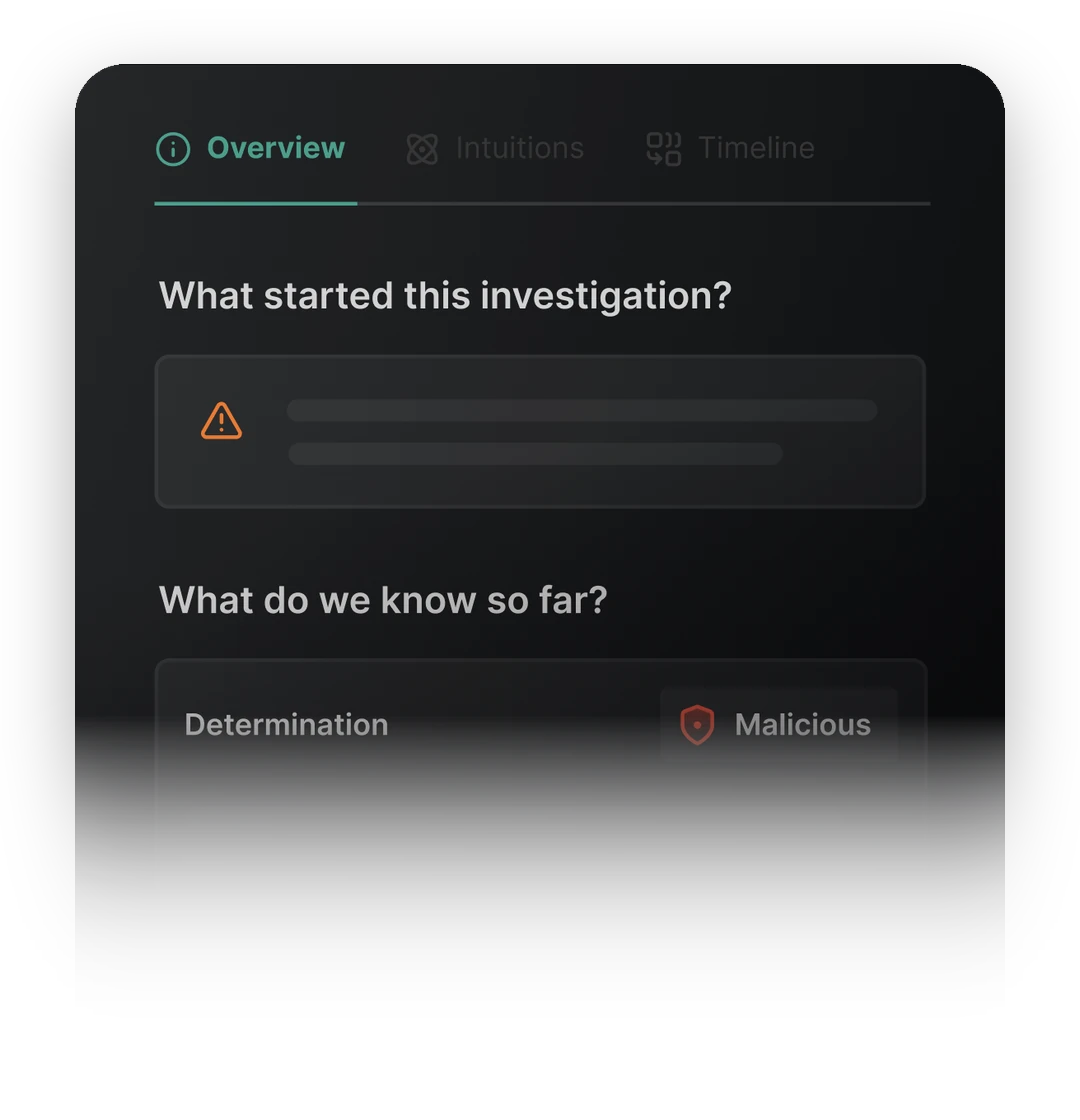
See how Prophet AI investigates alerts like yours, so your case to leadership rests on what you saw.

As the Director of Product Marketing at Prophet Security, Ajmal drives marketing and growth strategies and helps security professionals see how AI is transforming security operations.