


What is Agentic SOC?
.avif)
A skilled analyst can investigate any alert thoroughly given enough time. The problem has never been capability. It has been that thorough investigation takes 20 to 40 minutes per alert, and most SOCs see hundreds if not thousands per day. That math forces trade-offs: high-severity alerts get deep investigation, while low and medium alerts sit in a queue with minimal triage or get bulk-closed. Some percentage of those neglected alerts are real threats that escalate while the team is occupied elsewhere.
SOAR and enrichment tooling help by accelerating individual steps, pulling context, querying threat intel, correlating IOCs. But the analytical work of connecting that context into a coherent judgment still falls to a human, which means it still only happens at human speed and human volume.
An agentic AI SOC changes the equation by applying full investigative rigor to every alert, concurrently, in minutes. The gain comes from both the quality of the analysis and the fact that it scales across the entire alert queue without forcing teams to choose where to spend their attention.
{{ebook-cta}}
What "Agentic" Actually Means in a SOC Context
An agentic SOC is a security operations center where AI SOC agents investigate alerts autonomously, using reasoning and evidence gathering rather than predefined playbooks. The term borrows from AI research, where an "agent" is a system that perceives its environment, makes decisions, and takes goal-directed action without step-by-step instruction.
In practice, this means the AI decides what data to pull based on what it has already found. It builds an investigative thread, follows it, and produces a verdict with supporting evidence. A SOAR playbook answers the question "what steps should I run?" An agentic system answers a different question: "what is actually happening here, and does it matter?"
The defining characteristics are straightforward. Agents investigate end-to-end, from initial triage through verdict, without requiring human input at each step. They adapt their approach dynamically based on the evidence rather than following a static script. Every conclusion comes with a clear rationale that analysts can audit. Whether that autonomy can extend across the whole SOC is a separate question, examined in whether a fully autonomous SOC is achievable today. And humans retain authority over final response decisions.
How an Agentic SOC Differs from SOAR
The comparison matters because many organizations considering the agentic model have already invested in SOAR and are evaluating what comes next.
SOAR platforms codify analyst workflows into automated playbooks. The logic is sound: capture expert knowledge in repeatable scripts and apply it at scale. For well-scoped use cases, SOAR delivers. The challenge is that playbooks require someone to anticipate each scenario in advance, and they demand ongoing engineering as environments change. For teams with broad alert surfaces, the maintenance cost of building and updating playbooks can erode much of the efficiency gain they were designed to provide.
An agentic SOC takes a different approach by removing the playbook layer. Agents reason through each alert on its own terms, pulling the right telemetry, following the right investigative threads, and adapting when the evidence points somewhere unexpected. There is no workflow to pre-build, no branching logic to maintain, and no gap in coverage when a new alert type appears.
The operational difference shows up clearly in coverage and maintenance burden. A SOAR-augmented SOC investigates the alerts its playbooks were built for and ignores or shallowly triages the rest. An agentic SOC investigates every alert at the same depth, regardless of whether someone anticipated that specific scenario.
What an Agentic Investigation Looks Like
A suspicious login fires from an identity provider. An employee's account is authenticating from an unrecognized location during off-hours.
An agentic system starts the investigation immediately. It pulls identity logs, correlates endpoint telemetry for that user's devices, checks cloud access patterns, compares the behavior against peer baselines, and looks for correlated signals: new email forwarding rules, unusual file access, privilege escalation attempts. Within minutes it delivers one of two outcomes. Either this is a true positive with the full evidence chain attached, or it is benign with a specific explanation of why. The analyst reviews a completed investigation, not a raw alert.
This workflow has direct impact on the SOC metrics leaders track. Median time to investigate drops from 30-plus minutes to under five. Investigation coverage extends to 100% of alerts rather than the fraction most teams can manually review. And analysts spend their time on judgment calls, not data gathering.
Core Capabilities That Define the Model
Autonomous triage and investigation is the foundation. Agents investigate each alert by gathering evidence, correlating data across sources, and reaching a verdict. This eliminates the triage bottleneck and ensures consistent depth across every alert regardless of volume.
Cross-domain correlation matters because modern attacks span identity, endpoint, cloud, and email simultaneously. A suspicious login becomes far more meaningful when correlated with a new forwarding rule and unusual file access on the same endpoint. Agents connect these signals automatically.
Dynamic evidence gathering distinguishes the agentic model from scripted automation. If initial identity checks suggest a compromised account, the agent pivots to examine what that account accessed, whether credentials were changed, and whether lateral movement occurred. The investigation path follows the evidence, not a predetermined script.
Explainable findings are non-negotiable for analyst trust and audit readiness. Every investigation produces a clear narrative of what was found, what evidence supports the conclusion, and why it does or does not warrant response. This also means junior analysts can confidently act on findings that would previously require senior review.
Alert reduction through resolution, not suppression. Agentic systems resolve low-risk alerts with full investigations rather than auto-closing or suppressing them. The distinction matters operationally. Suppression hides alerts and introduces risk. Resolution demonstrates that the alert was investigated and found to be benign, with evidence to prove it.
Why the Agentic SOC Model Is Viable Now
Two things changed. First, large language models reached a level of reasoning capability where they can reliably analyze complex, multi-step security scenarios across disparate data sources. Second, integration architectures matured enough that agents can pull telemetry from SIEMs, EDRs, identity providers, cloud platforms, and email systems without months of custom connector work.
The demand side caught up at the same time. Most security teams have hit the ceiling on what they can achieve by adding headcount or building more playbooks. The agentic model offers a way to scale investigative capacity directly, without proportionally scaling the team.
What Changes Operationally
Adopting an agentic SOC fattens the security operations function.
Tier structures become less necessary. When every analyst has access to complete, evidence-backed investigations, the pressure on rigid Tier 1/2/3 escalation eases considerably. Junior analysts can handle cases that previously required senior review because the agent has already done the investigative work. The team can operate flatter and faster.
Analyst focus shifts from data gathering to decision-making. Instead of spending the majority of their time pulling logs and pivoting between tools, analysts review completed investigations and determine next steps. This is better use of experienced talent and a meaningful factor in retention.
Backlog dynamics change. When investigation happens autonomously at machine speed, alert backlogs shrink significantly. Every alert gets investigated as it arrives, which improves security posture in a practical way; the alerts that previously sat uninvestigated for days or weeks are often the ones that matter most.
How Prophet Security Enables the Agentic SOC
Prophet AI is an agentic AI SOC analyst that investigates alerts autonomously across identity, endpoint, cloud, and email. It reasons through each alert, gathers evidence across your stack, correlates signals, and delivers clear, auditable findings. No playbooks to build, no integrations to configure, no workflows to maintain.
Operationally, Prophet AI handles enrichment, cross-domain correlation, and verdict for every alert. Low-risk alerts are resolved with full evidence. Meaningful alerts are escalated with complete investigations attached. Investigation time drops from a 30-minute median to under five minutes, and coverage extends to 100% of alert volume from day one.
The agentic SOC model works because it solves the actual bottleneck in security operations.. Prophet AI is how that model gets deployed. Request a demo to see it.

Insights
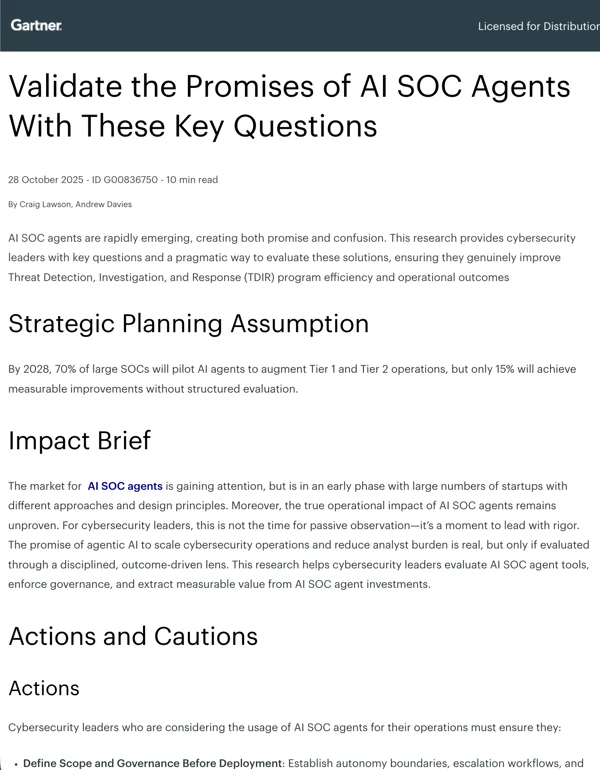
Not Every AI SOC Agent Delivers on the Promise
Leverage Gartner's list of specific questions to ask vendors before committing to a solution

As the Director of Product Marketing at Prophet Security, Ajmal drives marketing and growth strategies and helps security professionals see how AI is transforming security operations.