


Agentic MDR: Advantages and Disadvantages
.avif)
Within a single twelve-month window, three of the largest names in managed detection and response rebranded around the same idea. CrowdStrike introduced Falcon Complete Next-Gen MDR, which embeds AI agents to automate investigation and triage under analyst oversight. Arctic Wolf launched its Aurora Agentic SOC. Sophos reported a full year of agentic operation inside its MDR service, with AI closing more than half of cases end to end. The label these offerings converged on is agentic MDR, and for buyers it raises a fair question: is this a real shift in how the service works, or familiar managed detection with a new adjective?
The honest answer is both. Agentic MDR is a genuine change in the delivery model, and it's likely to carry forward the structural limits of that model. This piece defines the term, lays out the advantages and disadvantages how it differs from an agentic AI SOC platform you operate yourself.
What is agentic MDR?
Agentic MDR is a managed detection and response service in which autonomous AI agents, rather than only human analysts, triage and investigate the majority of alerts, escalating high-risk cases to humans for validation and response. The provider still runs the service. What changes is who does the first pass of investigative work: agents query telemetry, build and test hypotheses, and assemble a verdict, while analysts move to oversight and the decisions that carry real consequences.
This is distinct from an AI assistant that answers an analyst's questions on request. An agent in this context pursues a goal inside guardrails the provider defines, and it runs without waiting for a prompt. The same agentic ai pattern now drives the broader agentic soc conversation; agentic MDR is that pattern applied specifically to the managed-service business. It also overlaps heavily with what some vendors market as ai mdr, the two labels are used interchangeably in most of the market today.
{{ebook-cta}}
The advantages of agentic MDR
Speed that human-only tiers cannot match. Reporting a full year of production data, Sophos said AI now closes 52% of its MDR cases end to end and, on the cases it is authorized to resolve, acts in 89 seconds from case creation to automated response. CrowdStrike has reported up to 5x faster investigations and more than 3x higher triage accuracy in internal testing of its next-generation service. Whatever discount you apply to vendor figures, and these are vendor figures, the direction is real: machine-led triage compresses the minutes-to-hours an analyst spends opening, enriching, and closing routine alerts.
Consistency at volume. A human SOC degrades as the queue grows. Analysts skim, bulk-close, and deprioritize low-fidelity alerts that occasionally hold the first sign of an intrusion. Agents apply the same depth to the thousandth alert as the first, which is exactly where most managed services have historically thinned out.
Coverage and tooling you do not have to build. The provider invests centrally in integrations, detection content, and 24/7 staffing. A small team gets around-the-clock coverage without hiring, and without owning the maintenance burden of the toolchain.
Accountability that survives an audit. The better implementations log every agent action with machine-generated reasoning and keep a human accountable for response. Done well, that produces a defensible record of what happened and why, which matters when a regulator or an executive asks.
The disadvantages of agentic MDR
You still do not own the investigative logic. The agents run inside the provider's service, tuned to the provider's priorities. When you want to change how a class of alerts is handled, you file a request and wait, the same dependency that has frustrated buyers of traditional MDR for years.
Coverage often stays tier-1-centric. Faster triage of the alerts a provider already handles does not automatically extend the scope of what it handles. Many agentic MDR offerings accelerate the front of the funnel while leaving deeper investigation and custom work where it was.
Custom detections remain a gap. Most managed services run their own detection library and do not take on the bespoke rules your team wrote for your environment. Adding AI to the analyst workflow does not close that gap. We wrote about why your MDR will not cover the custom detections you built, and agentic delivery does not change the underlying economics.
Transparency depends on the vendor. An agent that investigates in seconds is only trustworthy if you can see the queries it ran and the evidence behind the verdict. Some providers expose this. Others give you a conclusion and a confidence score. The difference is invisible in a demo and decisive in an incident.
Lock-in and data questions. Agentic features are often tied to the provider's wider platform, SIEM, and pricing. Before committing, confirm where your data is processed, whether it trains shared models, and what leaving would cost.
Agentic MDR vs AI SOC: the ownership line
The cleanest way to evaluate the category is to separate the delivery model from the technology. Agentic MDR keeps the managed-service model and adds agents to it. An agentic AI SOC platform gives you the agents directly: software that runs in your own environment and that your team operates. That is the heart of the agentic MDR vs AI SOC decision, and it turns on three things: ownership, depth, and transparency.
Ownership means the investigative logic, the integrations, and the audit trail live with you rather than behind a service desk. Depth means every alert gets a full line of questioning regardless of severity, not just the slice a tier-1 queue prioritizes. Transparency means you see every query executed, the data retrieved, and how each piece of evidence shaped the verdict. Prophet Agentic AI SOC Platform was built on that premise, investigating every alert with a documented evidence trail; in one side-by-side across 12,000 investigations it reached 99.8% agreement with the customer's human team. Managed delivery is not the wrong choice for every team. The distinction that matters is narrower: an agent you operate and an agent a vendor operates produce different answers to the questions of control and visibility.
Where agentic MDR fits, and where it does not
For a team of one to four people with no realistic path to 24/7 staffing, a strong agentic MDR offering is a reasonable force multiplier, provided you verify the transparency and custom-detection limits before signing. For a maturing SOC that already has analysts and wants to move them off repetitive triage while keeping control of detections and the audit trail, the managed model can become the constraint rather than the fix. Teams in that position should weigh agentic MDR against running an AI SOC platform themselves, and should pressure-test any provider's claims against the criteria for evaluating MDR providers in 2026.
Agentic MDR is a real category, and it is improving a model that needed it. Just hold it to the standard you would hold any agent that touches your alerts: show me the reasoning, show me the accuracy, show me the coverage, and show me what I own.

Insights
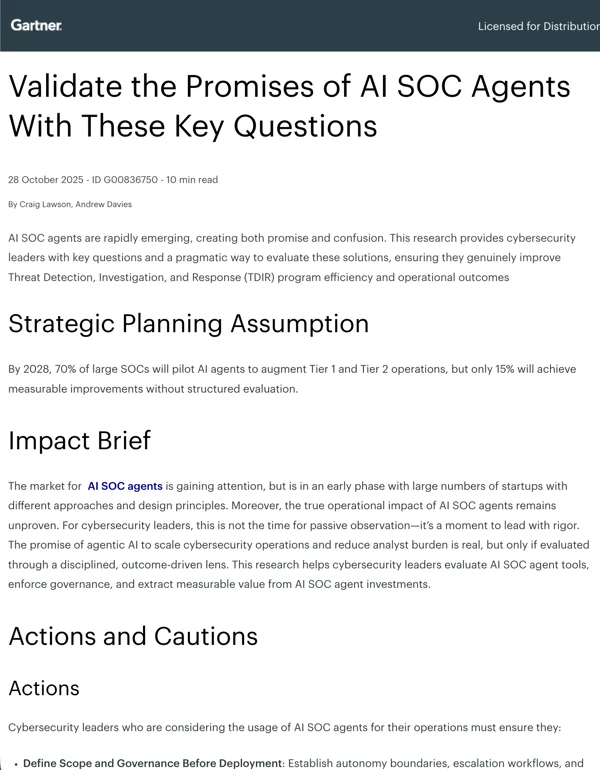
70% of SOCs will pilot AI Agents. Only 15% will see results
This Gartner research arms security operations leaders with a list of specific questions to ask vendors during evaluation

As the Director of Product Marketing at Prophet Security, Ajmal drives marketing and growth strategies and helps security professionals see how AI is transforming security operations.