


Key SOC Tools Every Security Operations Center Needs in 2026
.avif)
The frequency and severity of data breaches is a constant reminder that a well-equipped Security Operations Center (SOC) is vital for protecting organizations from cyber threats. With the right security operations center tools, SOCs can efficiently monitor, detect, and respond to potential incidents, thereby enhancing overall security operations. Leveraging advanced SOC tools, or SecOps tools, ensures that security teams can stay ahead of threats, minimize risks, and maintain a robust security posture. From endpoint detection to automated response, these tools are essential for a comprehensive defense strategy.
To help you navigate the complex world of SOC tools, we will explore key categories and top vendors in each area, highlighting their primary benefits and potential drawbacks.
1. Endpoint Detection and Response (EDR)
Overview: Endpoint Detection and Response (EDR) tools are designed to monitor end-user devices (endpoints) to detect and respond to cyber threats. These tools provide out of the box detection logic, visibility into raw endpoint telemetry to perform investigations, and empower users to contain hosts, ban files, and kill processes and network connections. As a security team, this should be among the first tools you consider in your arsenal.
Top Vendors:
- CrowdStrike
- Microsoft Defender for Endpoint
- SentinelOne
Benefits:
- Real-time monitoring and detection of endpoint threats
- Automated response and remediation capabilities
- Detailed forensic data for incident investigations
- Scalable to cover a large number of endpoints
Drawbacks:
- Can generate a high volume of false alerts, leading to alert fatigue
- May require significant configuration and tuning to optimize performance
- Endpoint telemetry is highly voluminous and can require significant expertise to understand and respond quickly
{{ebook-cta}}
2. Security Information and Event Management (SIEM) or Event Storage
Overview: Security Information and Event Management (SIEM) systems collect and analyze log data from various sources within an organization’s IT infrastructure. They provide centralized visibility, enabling the detection of security incidents through correlation and analysis of logged events. In some cases, organizations may just need to have logging information retained, but not readily available for search – which can be significantly less expensive.
Key sources may include network traffic/flow logs, VPN and multifactor authentication logs, DHCP logs, custom application logging, and any data needed for compliance retention.
Top Vendors:
- Microsoft Sentinel
- Splunk
- Sumologic
- AWS S3 / Azure Blob (Storage only)
Benefits:
- Centralized log management and analysis
- Real-time monitoring and alerting of security events
- Ability to easily build your own rules across multiple data sources
Drawbacks:
- Can be extremely expensive to operate and maintain
- High complexity in deployment and configuration
- Potential for high false positive rates if not properly tuned
3. Cloud Security Posture Management (CSPM)
Overview: Cloud Security Posture Management (CSPM) tools help organizations manage and ensure the security compliance of their cloud environments. These tools continuously monitor cloud infrastructure for misconfigurations, compliance risks, and security vulnerabilities. The leading initial access vector for ransomware operators has been public vulnerability exploitation, so identification and response to known vulnerability has become increasingly important for security teams.
Top Vendors:
- Wiz
- Orca
Benefits:
- Continuous monitoring of cloud environments
- Automated detection and, in some cases, remediation of misconfigurations
- Enhanced visibility into cloud assets and security posture
- Support for compliance standards and frameworks
Drawbacks:
- Can generate a large volume of findings, requiring manual prioritization
- Historically have not provided Detection and Response signal for threats (Wiz’s recent Gem acquisition changed that)
4. Cloud Detection and Response (CDR)
Overview: Cloud Detection and Response (CDR) tools are focused on detecting and responding to threats within cloud environments. They provide visibility into cloud-native activities and detect suspicious behaviors specific to cloud infrastructure. Given most security teams' lack of general cloud-native experience, having dedicated tooling to bootstrap your team and make threat identification easier is crucial, allowing your team to effectively safeguard your cloud environment without needing extensive cloud expertise.
Top Vendors:
- Gem
- Permiso
- ClearVector
Benefits:
- Specialized detection for cloud-native threats
- Real-time threat detection and response capabilities
- Scalable to accommodate dynamic cloud environments
Drawbacks:
- Potential for high costs depending on usage and data volume
- Requires integration with other security tools for comprehensive coverage
5. Response Automation
Overview: Response Automation tools streamline and automate the response to security incidents, reducing the time and effort required for manual interventions. These tools can automate repetitive tasks, orchestrate complex workflows, and ensure consistent response actions.
Top Vendors:
- Tines
- Torq
- Cortex XSOAR
Benefits:
- Accelerates incident response times
- Reduces the workload on SOC analysts
- Ensures consistent and repeatable response actions
- Integrates with a wide range of security tools and platforms
Drawbacks:
- Initial setup and configuration can be complex and time-consuming
- Requires ongoing maintenance and updates to workflows and integrations
- Actions are going to be static and highly alert dependent. No room for variability.
6. AI SOC platforms: investigation and triage automation
The most time-consuming part of a SOC’s workflow is investigating the constant stream of alerts generated across tools. AI SOC platforms like Prophet AI automate this process by acting as an agentic analyst: investigating alerts, asking the right lines of questioning, and delivering clear, explainable determinations. This goes far beyond static playbooks or enrichment dashboards — it’s dynamic reasoning at machine speed.
Our Benefits:
- Dramatically decreases incident response times
- Reduces the most challenging workload for SOC analysts
- Ensures consistent and repeatable investigative quality
- Not a “7th single pane of glass” - Integrates with your existing operational workflow in Slack, JIRA, ServiceNOW, etc.
How to get started
Discover how Prophet Security can lower your risk and boost Security Operations productivity by streamlining alert triage and investigation, freeing up your team to focus on more impactful tasks. Request a demo of Prophet AI to learn how you can triage and investigate security alerts 10 times faster.

Insights
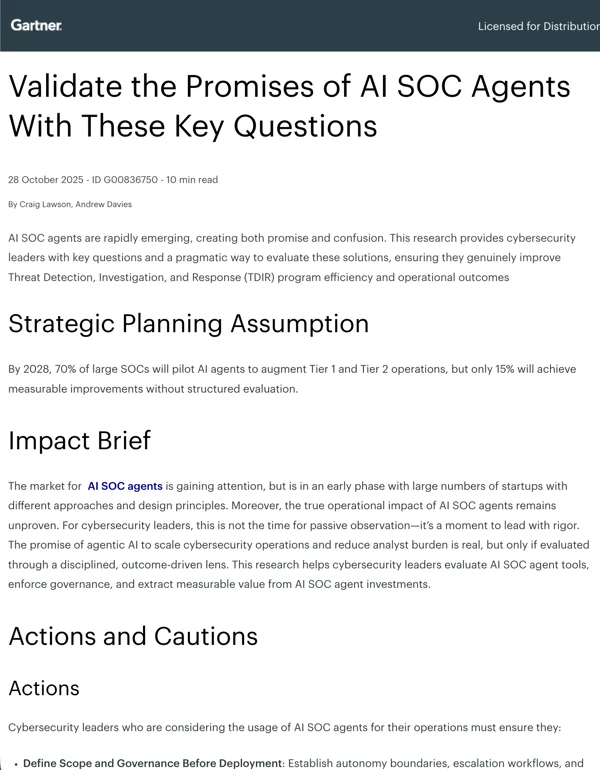
Not Every AI SOC Agent Delivers on the Promise
Leverage Gartner's list of specific questions to ask vendors before committing to a solution

As the Director of Product Marketing at Prophet Security, Ajmal drives marketing and growth strategies and helps security professionals see how AI is transforming security operations.