


Best Threat Hunting Tools: The Capabilities That Define Modern Hunting
In most security operations centers, threat hunting is the work that never happens. Detection and response consume the day, the alert triage queue never empties, and the proactive search for what the detections missed gets pushed to a quarter that never comes. For that reason, the best threat hunting tools will make hunting something a team actually does, repeatably, against the whole environment. The capabilities below are the ones that turn hunting from an occasional project into a routine practice.
Short answer: the best threat hunting tools share six capabilities. They give visibility across every security domain, support all three hunting modes, run a real workflow from evidence gathering through reasoning to action with full explainability, hunt continuously and on a schedule, turn validated hunts into permanent detections, and lower the barrier to entry enough that hunting becomes routine. A tool that does one of these well and ignores the rest leaves the program where it started.
What good threat hunting looks like
Threat hunting is the proactive search for adversary activity that existing detections did not catch. Mature hunting answers one question asked three ways.
- Historical validation asks whether you are impacted when a new threat report lands, testing external intelligence against your own history.
- Investigation scoping asks where else a known signal is happening, expanding it across the estate.
- Hypothesis-driven hunting asks what an attacker might be doing that no alert has flagged.
A good threat hunting tool has to serve all three, because mature hunting needs every mode working together, and a program limited to reacting to published intelligence covers only a third of the ground. For why most programs stall before they reach that maturity, see our blog on proactive threat hunting.
The capabilities that separate the best threat hunting tools
1. Visibility across every security domain
An adversary does not stay inside one tool, so a hunt cannot either. The best threat hunting tools query and correlate telemetry across identity (sign-ins, MFA events, OAuth grants, risk scores), endpoint (process trees, parent-child lineage, command-line detail), cloud (IAM changes, API calls, token usage, network flows), email (headers, malicious link clicks, mailbox changes), SaaS and data (file access and sharing), and the SIEM or data lake where historical logs live. The ability to ask one question across all of them in a single hunt is what removes the swivel-chair effect that kills most hunts before they finish.
{{ebook-cta}}
2. Coverage of all three hunting modes
As mentioned earlier, hunting typically spans three distinct activities: historical validation, investigation scoping, and hypothesis-driven hunting. A tool built only for retro-hunting handles the first and leaves the other two to manual work, which is where coverage gaps hide. The best tools make all three first-class.
3. A workflow that gathers, reasons, and acts, with explainability
Good hunting moves through three stages, and the tool should carry each. In the gather stage it retrieves and correlates the relevant logs automatically, so the analyst skips manual querying and starts at analysis. In the reasoning stage it works from the intent of the hunt and adapts to the behavior emerging in your environment, suggesting the logical next step. In the action stage it shows its work: the original source, the query logic, and the reasoning behind each finding, so an analyst can confidently escalate, respond, or promote a lead into a full incident. Explainability is what makes a finding actionable: an analyst escalates a hunt result with confidence only when they can trace the evidence behind it.
4. Continuous and scheduled hunting
The reason hunting programs stall is that they depend on someone finding spare time. The best threat hunting tools remove that dependency. They run continuously, watching for newsworthy and emerging threats and checking whether the related indicators are present in your environment without anyone starting the hunt. And they let you schedule recurring hunts that monitor for specific patterns or hypotheses on their own, codifying a validated hunt into reusable logic so it runs consistently without constant oversight. Hunting that runs on a schedule is hunting that actually happens.
5. A path from hunt to detection
A hunt that confirms a technique and then closes is a hunt you will run again. The best threat hunting tools let you promote a validated hunt into a permanent detection, pushing the logic to your upstream tools so the same behavior is caught automatically next time. That is the loop that connects hunting to detection engineering and compounds the value of every hunt over time.
6. A low barrier to entry, and a way to measure the program
A tool only helps if people use it. Natural-language hunting and libraries of ready-to-run hunt templates lower the skill and time barrier, so a mid-level analyst can run a sophisticated hunt without mastering a query language. Measurement matters just as much: dashboards and reporting that track active hunts, leads generated, and coverage against MITRE ATT&CK let a team prove the program is working and communicate it from a technical deep-dive up to an executive summary. A program you cannot measure is a program that loses its budget.
The six capabilities at a glance
How to evaluate a threat hunting tool
Skip the feature grid. Take one hunt of each mode and run it on your own data, then trace it end to end. Did the tool run it without a human starting it? Did it correlate across domains in a single pass? Could you see the query logic and evidence behind the result? Could you promote the finding into a detection? The tool that makes that loop easy is the one your team will actually use, and use is the only thing that turns hunting from a line item into a capability.
Where Prophet Security fits
Prophet Security's AI Threat Hunter is built around these capabilities. Analysts hunt in natural language across identity, endpoint, cloud, email, and SaaS; the platform gathers and correlates the evidence, reasons over the intent of the hunt, and shows the source and query logic behind every finding. It runs continuously against emerging threats, supports scheduled recurring hunts, and lets teams promote a validated hunt into a detection. Because the same platform also investigates the alert queue autonomously, the analysts who never had time to hunt finally do.
If your hunting program stalls because the queue always wins, see how the Prophet AI Threat Hunter works and where it fits alongside your existing tools.

Insights
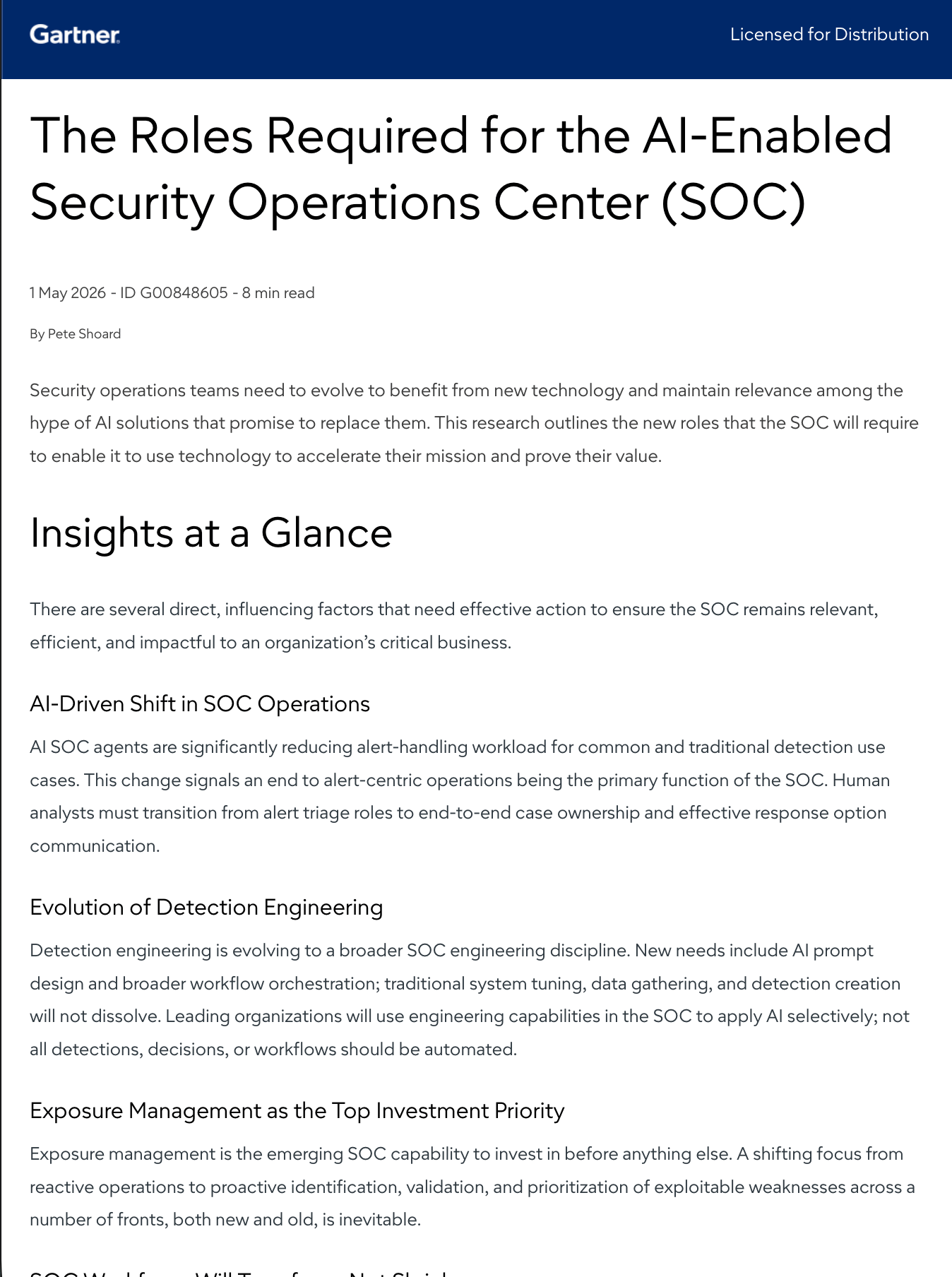
The Roles Your AI-Enabled SOC Will Need
Gartner research on how SOC roles shift as AI SOC agents reduce alert-handling work

.avif)
As the Director of Product Marketing at Prophet Security, Ajmal drives marketing and growth strategies and helps security professionals see how AI is transforming security operations.