


AI SOC Statistics: Adoption, Accuracy, and ROI Data
.avif)
The two clocks that define security operations moved in opposite directions this year. The CrowdStrike 2026 Global Threat Report puts average eCrime breakout time at 29 minutes. Prophet Security's survey of nearly 300 security leaders puts average alert dwell time, the gap between an alert firing and first human triage, at 56 minutes. The attacker's clock now runs roughly twice as fast as the defender's.
This page collects the AI SOC statistics that matter for that math: alert volume, investigation coverage, adoption rates, barriers, and cost data.
Key AI SOC statistics at a glance
If you only take one set of AI SOC statistics into a planning meeting, take these:
- Average eCrime breakout time fell to 29 minutes, with the fastest observed at 27 seconds (CrowdStrike Global Threat Report, 2026)
- 82 percent of detections were malware-free, built on valid credentials and trusted access (CrowdStrike, 2026)
- Security teams face an average of 960 alerts per day; large enterprises average 3,181 (Prophet Security State of AI in SOC survey, 2025)
- About 40 percent of alerts are never investigated (Prophet Security, 2025)
- Average alert dwell time before triage is 56 minutes (Prophet Security, 2025)
- Global average breach cost dropped to 4.44 million dollars; the US average hit a record 10.22 million (IBM Cost of a Data Breach, 2025)
- Organizations using security AI extensively cut breach lifecycle by 80 days and saved about 1.9 million dollars per breach (IBM, 2025)
- Security leaders expect AI to handle about 60 percent of SOC workloads within three years (Prophet Security, 2025)
How fast are attacks moving in 2026?
According to the CrowdStrike 2026 Global Threat Report, average eCrime breakout time fell to 29 minutes in 2025, a 65 percent acceleration from 2024, with the fastest observed breakout at 27 seconds. Breakout time measures the interval between initial compromise and lateral movement, which makes it the cleanest external benchmark for how fast triage and investigation have to run.
Two adjacent CrowdStrike findings shape what that speed means for detection. First, 82 percent of detections were malware-free: adversaries operated through valid credentials, trusted identity flows, and approved SaaS integrations rather than droppable payloads. Second, AI-enabled adversary operations grew 89 percent year over year, with documented cases of attackers injecting malicious prompts into legitimate GenAI tools at more than 90 organizations.
Read together, the attacker-side numbers describe intrusions that look like normal business activity and move in minutes. That is the demand curve any SOC capacity plan has to clear.
{{ebook-cta}}
SOC alert volume statistics: what teams actually face
Prophet Security's 2025 State of AI in SOC survey of nearly 300 CISOs, SOC leaders, and practitioners found security teams face an average of 960 alerts per day. Large enterprises, those above 20,000 employees, average 3,181 alerts per day generated by an average of 28 separate security tools. SOC alert volume statistics scale with stack complexity more than with headcount, which is why adding tools without consolidating signal tends to make coverage worse.
According to the same survey, approximately 40 percent of security alerts are never investigated. An experienced analyst can fully work 20 to 30 alerts in a shift; at three-digit daily volume, something has to give, and what gives is coverage. Alert fatigue statistics usually measure the symptom, analyst exhaustion. The uninvestigated-alert rate measures the consequence: the alerts nobody opened are where intrusions that evade initial detection persist.
The dwell-time finding closes the loop: 56 minutes on average between an alert firing and first triage. Against a 29-minute average breakout, the average alert is touched almost half an hour after the average attacker has already moved laterally. For the structural causes behind these numbers, see our primer on AI SOC, and for tactical mitigation, our guide to reducing alert fatigue.
AI SOC adoption statistics
The AI SOC adoption statistics from independent surveys agree on direction and disagree, usefully, on maturity.
In Prophet's 2025 survey, AI for Security ranked among the top three security priorities, cited by roughly 33 percent of leaders, behind data security (53 percent) and cloud security (37 percent). The same respondents expect AI to handle about 60 percent of SOC workloads within three years.
The SANS 2025 SOC Survey (Christopher Crowley, July 2025) shows where current deployments actually stand. Roughly 40 percent of SOCs report their teams use AI and ML tools without those tools being a defined part of operations, and AI/ML ranked at the bottom of the technology satisfaction list, with generative language tools scoring 2 out of 4. Meanwhile 69 percent of SOCs still report metrics through manual or mostly manual processes, and 85 percent trigger incident response primarily from endpoint alerts.
SOC automation statistics often blur two different things: scripted playbook execution and autonomous investigation. The SANS satisfaction data mostly reflects the first generation of tooling, bolted-on assistants and uncustomized ML, deployed without ownership or integration plans. The expectation gap between "60 percent of workloads in three years" and "lowest satisfaction today" is the clearest signal in this year's data: leaders are committed to the destination and unimpressed with most current vehicles.
What does AI in the SOC return? Cost and ROI data
Per IBM's 2025 Cost of a Data Breach report, organizations using security AI and automation extensively shortened breach lifecycles by 80 days and saved about 1.9 million dollars per breach on average. The global average breach cost fell 9 percent to 4.44 million dollars, the first decline in five years, a drop IBM attributes largely to faster identification and containment. The US average moved the opposite direction, up 9 percent to a record 10.22 million dollars.
Those are population-level numbers. The first-party data point we can add, clearly labeled as ours: in a side-by-side evaluation at one Fortune 500 manufacturing organization, Prophet AI reached 99.8 percent agreement with the human analyst team across 12,000 investigations, while reducing typical investigation time from 30 to 60 minutes to under 5. We publish it because category-level accuracy claims are unverifiable; named, countable evaluations are the standard buyers should hold every vendor to, including us. The cost side of that argument is built out in our analysis of the ROI of AI in the SOC.
What blocks AI adoption in the SOC?
In Prophet's 2025 survey, the top barrier to AI adoption was data privacy and regulatory compliance, cited by 24 percent of respondents, with integration complexity second. Fear of AI replacing humans came in at 15 percent and accuracy concerns at just 10 percent, a lower trust barrier than most vendor messaging assumes.
IBM's 2025 data adds the governance dimension: 63 percent of breached organizations had no AI governance policy, and shadow AI usage added an average of 670,000 dollars to breach costs. The barrier data and the governance data point at the same conclusion. Privacy, deployment model, and auditability questions decide these purchases, which is why evaluation criteria like single-tenant options, data retention terms, and evidence trails have moved from procurement footnotes to first-call questions.
Where the numbers point through 2027
Security leaders expect AI to handle roughly 60 percent of SOC workloads within three years. Set that against the present-day baselines in this page: 40 percent of alerts uninvestigated, 56-minute dwell, AI/ML at the bottom of the SANS satisfaction table. The projection only reconciles with the baseline if the next generation of deployments behaves differently from the first, with defined ownership, deep integrations, and investigation-grade output rather than enrichment summaries. The AI SOC statistics on this page give you the before picture; the next two refresh cycles will show whether the category delivers the after.

Insights
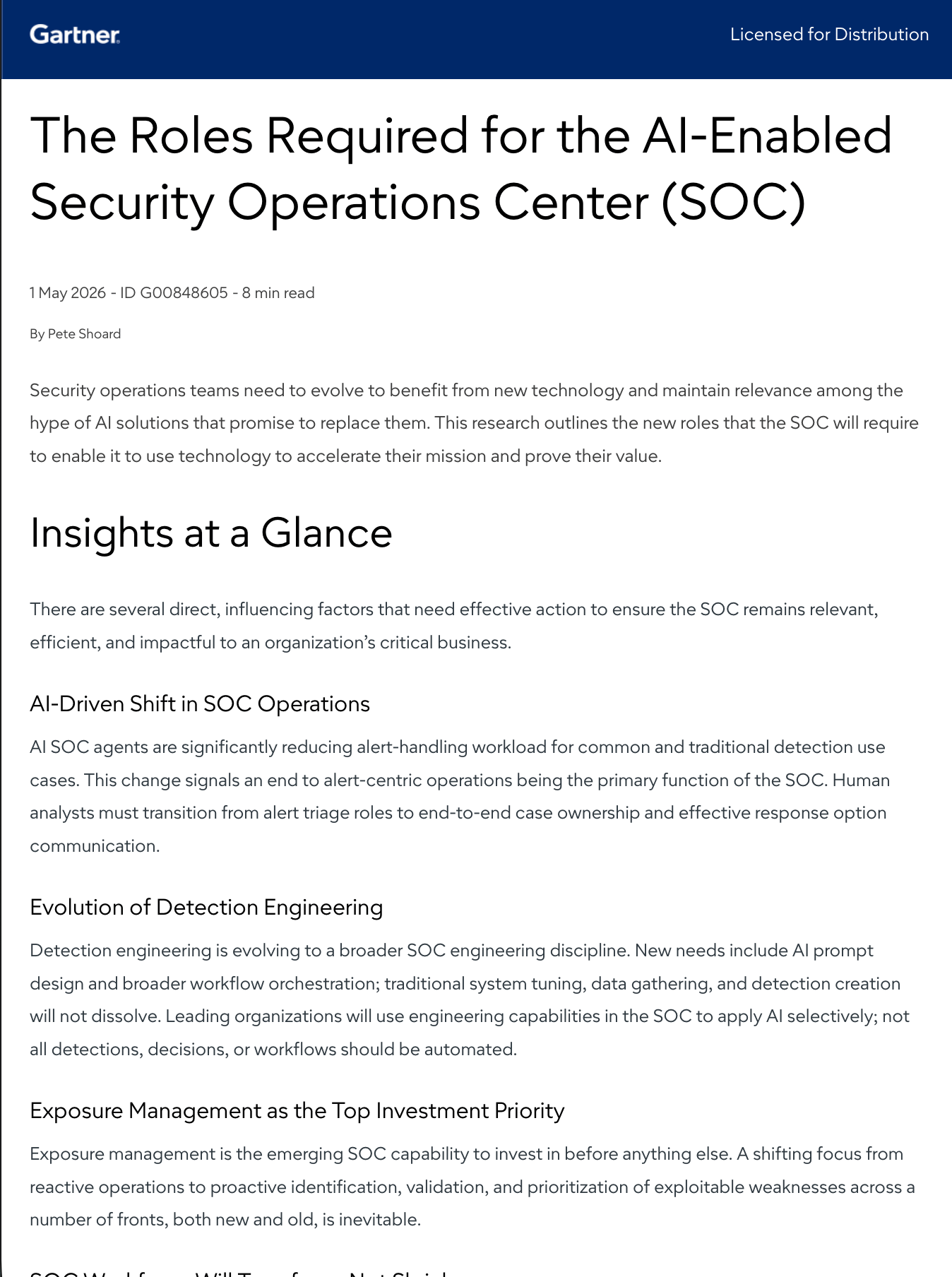
The Roles Your AI-Enabled SOC Will Need
Gartner research on how SOC roles shift as AI SOC agents reduce alert-handling work

As the Director of Product Marketing at Prophet Security, Ajmal drives marketing and growth strategies and helps security professionals see how AI is transforming security operations.