


AI Tools for Investigating Impossible Travel Alerts and Anomalous Logins
.avif)
It takes a single tool to raise an impossible travel alert but investigating and verifying it requires you to traverse several tools and data sources. An identity provider notices that a sign-in came from two places too far apart to be plausible, attaches a risk label, and stops. The key evidence sits in other systems. To understand what took place, you have to look elsewhere to verify the geolocation, check if the device belonged to the user, and see what happened after the sign in.
Recently, a host of AI-powered tools have popped up promising to let you offload the investigation and resolution of this class of security alerts. In this blog we examine the main categories of AI tools for investigating impossible travel alerts and anomalous logins, and how each fares on this class of identity alert. We examine how far each one carries a case through alert triage and investigation, to response and remediation.
{{ebook-cta}}
Challenge of investigating Identity alerts
Anomalous login and impossible travel alerts are voluminous and noisy. This class of alerts lack true behavioral context, which results in a high volume of false positives and subsequent alert fatigue for security operations teams. The mechanical reasons are numerous and include VPN and proxy usage, mobile network fluctuations, shared account usage, and routine travel.
The documented causes of impossible travel false positives are consistent across vendors. Microsoft states that its algorithm deliberately ignores VPNs and locations regularly used by other people in the organization, which is a concession that the raw signal is noisy enough to require suppression. Elastic’s prebuilt rule documentation names VPN infrastructure, mobile carriers whose addresses resolve outside the user’s home country, and virtual desktop infrastructure as expected false positives. Both Microsoft detections also carry a learning period, seven days for Defender for Cloud Apps and the earlier of fourteen days or ten logins for Entra ID Protection, during which a new user has effectively no baseline.
On the other end, malicious activity can also bypass built-in controls. A passed multi-factor prompt can still hide the presence of an attacker. Session token theft produces an authenticated session that satisfies every control the identity provider checks, so understanding the true nature of the login requires analyzing the activity after the login.
Which tier of tool actually closes an identity case
Identity providers, SIEMs, and SOAR platforms all raise or route an impossible travel alert, but only AI SOC platforms carry it to an evidence-backed verdict without an analyst driving the investigation.
The AI tools for investigating impossible travel alerts on a typical shortlist fall into four tiers, ordered here by how far each one takes the alert. The first three do their jobs well and hand the decision back to a person. Prophet Security sits in the fourth tier as an agentic AI SOC platform that investigates every alert and returns a determination with the full evidence trail attached, including the queries it ran, which a reviewer can copy and run independently.
The four tiers differ in what they do with the alert and where they stop.
| Tier | What it does with the alert | Where it stops |
|---|---|---|
| Identity providers | Raise the signal from their own sign-in telemetry | Hands a hedged risk label to a human |
| SIEM and detection content | Correlate, baseline, and rule-match across sources | Hands a workspace and a query language to a human |
| SOAR and workflow automation | Run predefined enrichment and containment steps | Hands the true-or-false question to the user or a threshold |
| AI SOC platforms | Run the investigation across identity, endpoint, and cloud | Returns a determination with an evidence trail |
AI SOC platforms: the tier that returns a verdict
AI SOC platforms share a common set of capabilities and differ in how much of the identity workflow each has documented. Prophet's approach to this alert class is described below.
Prophet Security. Best for teams that need every identity alert investigated at senior-analyst depth with an auditable trail. Prophet AI plans each investigation dynamically, queries the identity provider, endpoint, cloud, and email sources the team already runs, and reaches a determination it stands behind, including recording a case as inconclusive rather than guessing when the evidence does not support a call. The capability that matters most to buyers evaluating this queue is verification. Every question asked and every query executed is recorded, so a reviewer can reproduce the reasoning instead of accepting an accuracy figure on trust. Customer data never trains the models, deployments are single-tenant, and the data plane can run inside the customer’s own VPC.
Platform-native agents from Microsoft, CrowdStrike, and Google
Every large platform now ships an agent, and cloud-committed teams generally try the native option first. The identity alert triage tools built into these platforms are strongest where the platform already owns the data and weakest at the edges where another vendor owns the identity provider or the endpoint.
CrowdStrike. Charlotte AI Detection Triage has been generally available since February 2025 and covers endpoint, identity, and cloud detections, with identity sources including on-premises Active Directory, Entra ID, and Okta. CrowdStrike reports over 98% triage accuracy and its datasheet qualifies that number as benchmarked against its own Falcon Complete analysts. The agent achieved FedRAMP High authorization in November 2025. CrowdStrike’s own word for the output is a recommendation, and it has not published an impossible travel investigation workflow.
Microsoft. Microsoft’s identity investigation story is assembled from components at different stages of release. The Sentinel data lake reached general availability in September 2025, while the Sentinel graph and the Security Copilot agents in Sentinel remain in preview. On the Entra side, the Conditional Access Optimization Agent is generally available and the Identity Risk Management Agent is in preview. The Sentinel MCP server splits by tool collection, with the data lake and triage collections generally available and the graph collection in preview. Microsoft’s own identity examples take the form of prompts a person writes, such as asking whether a given user is compromised, which puts a person in the loop for every question asked. Confirm availability status directly before relying on any of it.
Google SecOps. Gemini in Google SecOps generates searches from natural language, authors YARA-L rules, and summarizes cases. Its Triage and Investigation Agent analyzes alerts to determine whether they are true or false positives and returns a structured analysis with its findings. Google’s own blog describes the agent rendering a verdict with a transparent audit log and states that it was expected to preview for select customers, and the product documentation does not label a general availability status. Google does not document an impossible travel detection of its own, so treat the detection and the triage layer as separate questions.
What identity providers actually give you
This tier raises the alert and hands it over. Any anomalous login alert investigation begins where the identity provider stops.
Microsoft Entra ID Protection. Entra’s own detection is atypical travel, which identifies two sign-ins from geographically distant locations and weighs the time between them against the travel time required. Microsoft describes the result as an indication that a different user might be using the same credentials, which is a deliberate hedge. The detection is calculated offline rather than in real time and requires Entra ID P2. The impossible travel detection surfaced in Entra is not Entra’s own and is ingested from Defender for Cloud Apps, which is a distinction worth confirming during a bake-off. Microsoft’s documented investigation procedure is manual throughout: check the sign-in logs, contact the user, then mark the risk yourself.
Okta. Okta’s velocity behavior compares the time and location of two successive successful sign-ins and calculates whether the travel between them is physically possible, with a default threshold of 805 kilometers per hour that administrators can change. Related behaviors carry their own lookback windows, including new geo-location against the last twenty successful sign-ins and new IP against the last fifty. The important detail for buyers is that Okta behavior detection produces no alert and no incident. It emits a policy signal that a sign-on policy consumes in order to prompt for an additional authenticator, so there is no analyst-facing verdict or evidence bundle to review. ThreatInsight is a separate capability aimed at credential stuffing and password spray, and Okta states that it cannot guarantee complete malicious IP or threat detection. Our step-by-step guide to investigating Okta alerts covers what a human does with that signal.
Google Workspace. Google alerts administrators when a sign-in does not match a user’s normal pattern. The sequencing is worth knowing: Google first presents the user with an additional challenge, and the administrative alert fires when the user fails or abandons it. The security investigation tool is a separate, manual surface and is gated to specific editions.
What the SIEM tier gives you
This tier correlates and hands a human a workspace. A person still has to investigate suspicious login activity case by case, in a query language, against whatever data was onboarded. The tradeoff is covered in more depth in our comparison of SIEM and AI SOC approaches to the triage bottleneck.
Splunk. Splunk User Behavior Analytics applies behavior modeling, peer-group analysis, and unsupervised machine learning to establish baselines for users and entities and surface deviations from them. Two documented models cover VPN login location anomalies. Splunk does not document an impossible travel model as such, so a team expecting one should confirm coverage against its own use case. Note also that Splunk UBA runs on dedicated on-premises or managed cloud servers rather than as an application inside the Splunk platform, which makes it a procurement decision as much as a configuration one.
Elastic Security. Elastic ships a prebuilt rule named Microsoft Entra ID Impossible Travel Sign-in, a high severity rule of Elastic’s esql type with a risk score of 73. Its thresholds are documented explicitly: at least 500 kilometers of separation within a 90-minute window at an implied speed of 800 kilometers per hour or above. Elastic also ships a second, weaker rule for M365 portal logins. It defines impossible travel as two different countries in a short window, with no distance or speed threshold at all. Two rules carrying the same name can behave very differently.
Where SOAR fits
SOAR platforms typically approach impossible travel alerts by following fixed, automated playbooks. When a login occurs, the platform calculates distance and implied travel speed between sign-in locations using standard formulas. If the calculated speed exceeds a predefined threshold, the alert is flagged, and the system can automatically execute containment actions, such as forcing a password reset or revoking active user sessions across applications.
To determine whether the login is legitimate, SOAR platforms generally rely on user verification rather than deep evidence analysis. The system prompts the user via email, Slack, Teams, or SMS to confirm whether they initiated the login. While this automates the response flow, the final decision rests on user confirmation or static threshold rules. As discussed in our look at where static playbooks run out, relying strictly on rigid playbook logic limits how effectively teams can investigate complex identity alerts at scale.
The limitation of “AI” in identity alerts
Most AI tools for investigating impossible travel alerts describe their intelligence as AI, and in identity security today that usually means behavioral analytics. It learns a user’s habits, like their usual login times, devices, or network locations, to filter out expected noise from sources such as corporate VPNs. This is helpful for ranking alerts by risk, but it does not resolve them.
Even a perfectly ranked list still puts the burden on the analyst. They still have to manually verify the device, check the logs, look for post-login activity, and decide if the alert is malicious or benign. Precise ranking does not change the fact that investigation is a human-led, time-consuming process.
That is where the AI SOC (the fourth tier) differs. Instead of simply ranking the alert by risk, it conducts the investigation and reaches a verdict, lifting the burden off the analyst entirely.
What to require of AI tools for investigating impossible travel alerts
Five requirements separate the tiers in practice, and they apply to every tool named above.
- Cross-source reach inside one case. The tool has to read the identity provider, the endpoint, and the cloud audit trail within a single investigation, not hand back three enrichments to assemble.
- Post-authentication coverage. It has to answer what the session did after the sign-in succeeded, including token creation, group changes, identity-provider configuration changes, and mailbox rules.
- A determination rather than a bundle. The output should be a stated conclusion, not a folder of context with the decision still open.
- A reproducible evidence trail. A reviewer should be able to see every query that ran and execute it independently. This matters more here than in most queues, because the benign verdict is the common one and each benign closure may need defending later.
- An honest inconclusive. A tool that always produces a confident answer is producing confident wrong answers on the cases where the evidence genuinely does not decide.
Use these five as the checklist when you compare AI tools for investigating impossible travel alerts, and measure each one against the manual investigation method your team runs today.
If you want to see what a completed identity investigation looks like with the reasoning attached, Prophet Security will run one against your own alerts during a proof of value.

Insights
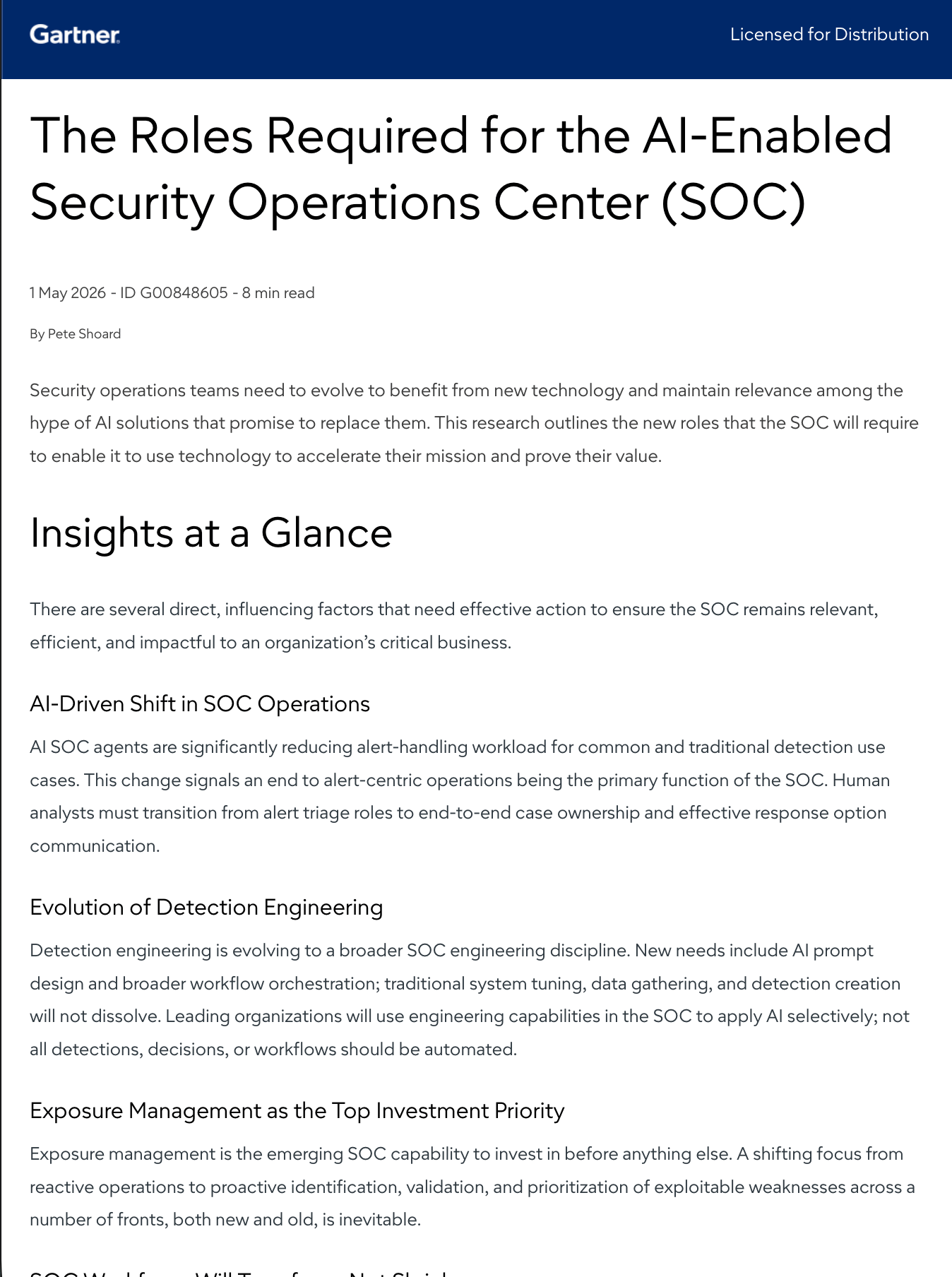
The Roles Your AI-Enabled SOC Will Need
Gartner research on how SOC roles shift as AI SOC agents reduce alert-handling work

As the Director of Product Marketing at Prophet Security, Ajmal drives marketing and growth strategies and helps security professionals see how AI is transforming security operations.