


What Zscaler Agentic SOC Means for Security Operations
.avif)
Zscaler Agentic SOC is a set of AI agents that investigate security alerts using the traffic data Zscaler already inspects for its customers. The agents can also block a threat while it is still passing through Zscaler. Zscaler launched the product on September 9, 2026, and says it pairs models from AI labs, including Anthropic and OpenAI, with its own threat intelligence.
Zscaler's launch landed between two others. A week earlier, CrowdStrike described the next version of its own agentic SOC at its Fal.Con conference. Two weeks later, Microsoft announced ISOC, which it presented as a step toward an agentic SOC. Each vendor started from the data its own products already collect. For a security team that runs more than one of them, that raises a practical question: whose agents should investigate an alert that starts in another vendor's tool?
A team weighing Zscaler Agentic SOC needs three answers: what Zscaler shipped, how its agents work with other vendors' tools, and what to check before it goes into a SOC plan.
{{ebook-cta}}
What Zscaler announced with Zscaler Agentic SOC
According to Zscaler's press release, Zscaler Agentic SOC combines five parts: Zscaler's own telemetry, a decoy mesh network, AI agents, Zscaler's Zero Trust controls, and the customer's third-party controls. Zscaler says its telemetry covers 750 billion transactions a day across network, identity, endpoint, cloud, and AI.
Between them, the release and the product page describe these capabilities:
- Context graph. It links Zscaler telemetry with data from third-party tools.
- Specialized AI agents. They triage and investigate alerts. Zscaler says they were trained on more than 10 years of SOC, managed detection and response, and threat-hunting experience.
- Inline containment. Zscaler can isolate compromised users, block command-and-control traffic, and cut off lateral movement.
- Deception. Alerts from the decoy mesh are one of the Zscaler sources the agents work from.
- Threat hunting. Zscaler and Red Canary experts hunt continuously, working with AI.
Red Canary's experts joined through Zscaler's acquisition of Red Canary, which closed on August 1, 2025. Zscaler says Agentic SOC is available globally now. Even so, the press release, the product page, and the solution brief give no prices, editions, or license terms. The brief lists Agentic SOC as one of four parts of a broader offering it calls Zscaler Agentic SecOps, next to exposure management, deception, and expert services. It does not say how the four are sold.
Who Zscaler Agentic SOC is built for
Zscaler's product page calls Agentic SOC "purpose-built for Zscaler customers," because its agents use the inline security telemetry and Zero Trust controls those customers already have. Its FAQ compares that approach with "overlay software that sits on top of existing alerts." In Zscaler's description, overlay tools run automation scripts on alerts that are noisy and short on context. Zscaler says its agents start instead from inline traffic data, enriched with identity, device posture, and application context.
Zscaler also pitches the product as a way to cut SIEM bills. The product page says Agentic SOC "complements your existing SIEM rather than forcing a total replacement." A team can investigate Zscaler traffic on Zscaler's platform without first forwarding the raw logs, then "forward only the distilled output to your SIEM as needed." In Zscaler's model, the SIEM stays in place for long-term compliance storage, audit reporting, and log aggregation.
Microsoft ISOC, announced two weeks later, makes a similar offer for Microsoft data. It includes Defender data without separate ingestion and charges $2.40 per gigabyte for data from other vendors' tools. Zscaler's public materials do not say whether data from non-Zscaler tools costs extra.
How Zscaler's agents handle alerts from other tools
Zscaler says the product connects "signals from Zscaler, endpoint, identity, email, and cloud tools" through connectors, entity mapping, and the context graph. The solution brief refers to "third-party security tools" and "third-party signals." Yet none of the three documents names a third-party security tool that connects.
An integration can do three jobs during an investigation: deliver an alert, answer a query for more evidence, or carry out a response. Zscaler's launch materials describe pulling third-party data into the context graph and triggering actions in third-party tools. They do not say what data each connector brings in.
Take a suspicious sign-in flagged by Okta. Working an Okta alert like that usually means pulling the user's recent sign-in history, the process activity on the user's laptop, and the web traffic from around the same time. Zscaler's agents have the web traffic already. Zscaler's help docs also list Okta and EDR connectors. The EDR connectors bring in alerts, incidents, assets, and vulnerabilities, not a feed of the laptop's process activity. Without it, the agents cannot fully confirm or clear the sign-in. The same check applies to an EDR alert or a phishing report: whether the agents can pull the process tree or the original email, or see only the alert.
How Zscaler Agentic SOC contains threats
Zscaler sits inline between users and the apps they use, so its agents can act on traffic directly. The product page says native controls can block or unblock URLs, files, and source IPs, and isolate threats inline. Playbooks can chain those controls with third-party ones. Teams can also "launch third-party SOAR workflows and bi-directional ITSM tickets."
Teams choose how much runs without them. Zscaler says they can "execute playbooks manually with human oversight or enable full automation" as confidence grows. The page also says teams can match response actions to incident severity and risk, to limit disruption to the business. Before turning on full automation, a team still has to decide what to automate and which actions stay with an analyst.
Zscaler backs the agents with people. The solution brief describes 24x7 managed detection and response expertise that "taps Zscaler inline telemetry." Zscaler's materials do not say whether that service comes with Agentic SOC or is sold on its own. A team that already pays an MDR provider should ask how the two would overlap. It should also decide whether agents could replace an MDR in its plan or work next to one.
How Zscaler Agentic SOC answers five agentic SOC questions
Zscaler Agentic SOC works from the traffic data Zscaler already inspects, and how far its agents can investigate alerts from other tools depends on connectors its launch materials do not list.
Anthropic, one of the AI labs Zscaler works with, draws a clear line in its guide to building effective agents. It describes workflows as "systems where LLMs and tools are orchestrated through predefined code paths." Agents, by contrast, "dynamically direct their own processes and tool usage." Five questions apply that line to a SOC product, and they work for any agentic SOC platform on a shortlist. Here is how Zscaler's public materials and Prophet AI answer them:
| Question | Zscaler Agentic SOC (public materials) | Prophet AI |
|---|---|---|
| Starts on its own when an alert fires? | Specialized agents run automated triage. The product page does not say whether every alert is triaged on arrival. | Investigates 100% of alerts, at every severity, the moment they arrive |
| Decides its next step from what it finds? | Zscaler's public pages do not describe how agents choose investigation steps. Their playbook language covers response. | Plans each investigation dynamically. A risky Entra ID sign-in can lead it to Okta sign-in history, CrowdStrike Falcon activity on the user's laptop, and Zscaler web traffic. |
| Reaches evidence in every tool? | Zscaler telemetry natively. Signals from endpoint, identity, email, and cloud tools through connectors, with no third-party tools named in its launch materials. | Read-only access for investigation to the tools a team already runs, including Okta, CrowdStrike Falcon, Zscaler, Proofpoint, AWS, Splunk, Defender, Entra ID, and Sentinel |
| Finishes with a determination? | Yes. Zscaler says its agents "display both supporting and contradictory evidence for every determination." | Reaches a determination, with every question, query, and reasoning step documented |
| Acts only within limits the team sets? | Playbooks run with human approval or automatically, and teams can turn on full automation as confidence grows. | Scoped, permissioned remediation, from notifications to quarantining a machine, limited to actions the team has approved |
Sources: Zscaler's press release, product page, and solution brief; Prophet Security's AI SOC Analyst and integrations pages.
For a team whose alerts come from many vendors, read the third row first, because an agent can only follow evidence it can reach. Zscaler's depth on its own traffic is an advantage for web, private-app, and data loss cases. For investigations that start in identity, endpoint, or email tools, a team can keep Zscaler for inline response. It can then add an AI SOC platform that reaches the rest of the stack.
What to check before Zscaler Agentic SOC becomes the SOC plan
Before Zscaler Agentic SOC goes into the SOC plan, the security team should answer ten questions with its own alerts and its own numbers:
- Alert sources. What share of the team's alerts comes from tools other than Zscaler, and which of those tools have a Zscaler connector today?
- Coverage. Does every alert get a full investigation at every severity, or only the alerts that triage ranks highest?
- Connector depth. For each connector, does the agent receive only the alert, or can it query the tool for more evidence during an investigation?
- Who decides. When an alert arrives, does an agent plan the investigation from what it finds, or does it follow a predefined playbook?
- Adaptability. Can the team teach the agents what is normal in its environment, such as an approved admin tool or a planned pen test? When an analyst corrects a verdict, does the next investigation reflect it, and can the team review the change before it applies?
- Lock-in. If the team moves off Zscaler later, what happens to its investigations and automations?
- Data and models. Which data reaches the Anthropic and OpenAI models, and is any of it used to train them? Where is third-party data stored, and for how long?
- Price. How is Agentic SOC licensed, does data from other tools cost extra, and is the MDR service part of the price?
- Accuracy. How is verdict accuracy measured, on what sample, and who checks it after go-live?
- Evidence. For a sample of verdicts, can analysts rerun the queries and see the supporting and contradictory evidence behind each one? The explainability test applies to every vendor.
A proof of value on the team's own alerts answers most of these with measured results.
What Zscaler Agentic SOC means for security operations
Zscaler Agentic SOC gives Zscaler customers AI investigation and inline response on the traffic they already send through Zscaler. It also lets them forward only the results to their SIEM. For the rest of the alert queue, its value depends on connectors, connector depth, and pricing that Zscaler's launch materials do not cover.
Prophet AI investigates every alert across the tools a team already runs, Zscaler and non-Zscaler alike. See how it works on your own alerts.
Insights
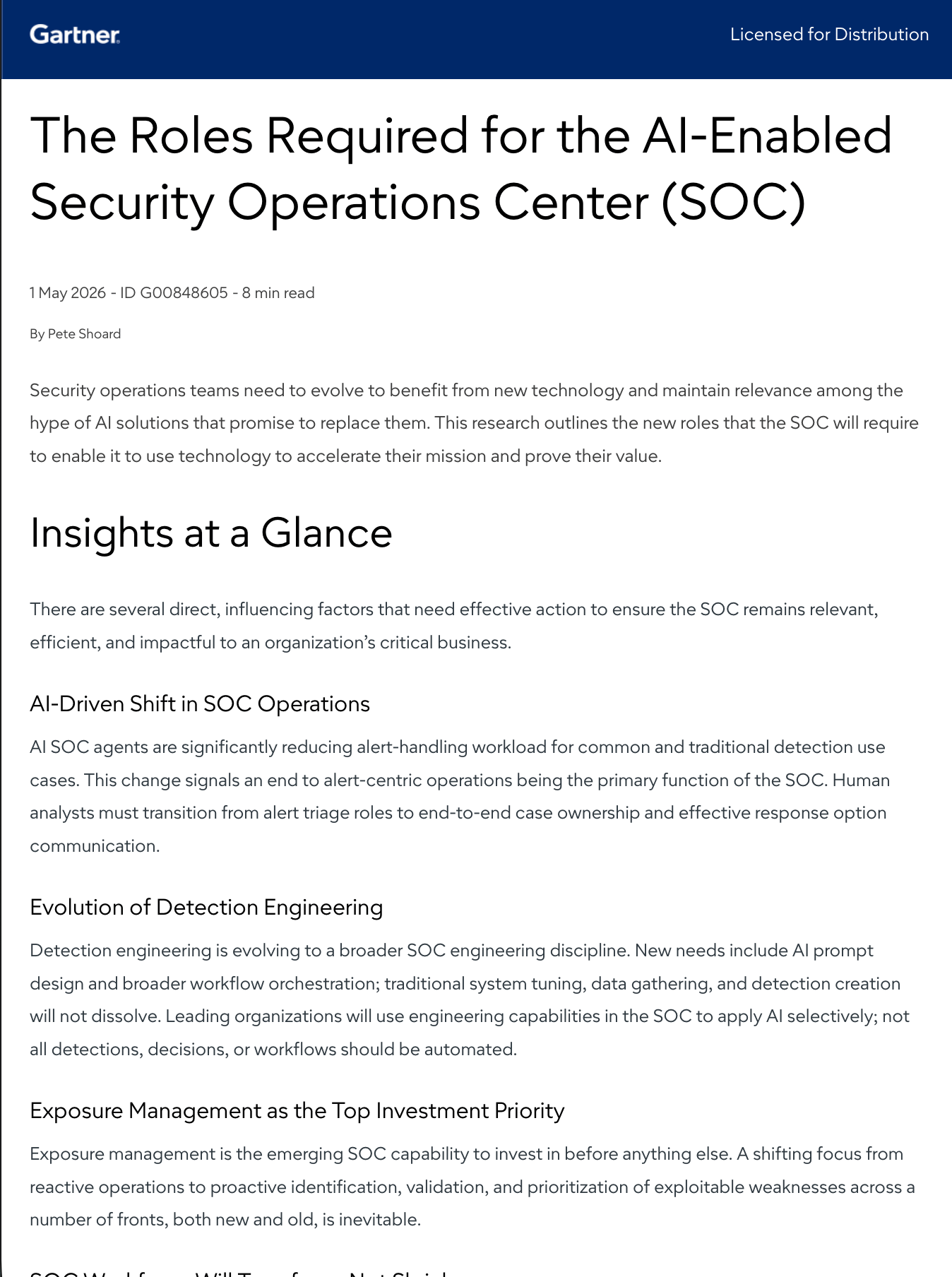
The Roles Your AI-Enabled SOC Will Need
Gartner research on how SOC roles shift as AI SOC agents reduce alert-handling work

As the Director of Product Marketing at Prophet Security, Ajmal drives marketing and growth strategies and helps security professionals see how AI is transforming security operations.