


AntiFox AI Attacks on AWS: How to Check CloudTrail and IIS

AntiFox is an open-source platform, built as a fork of ARTEX, that uses AI agents to run penetration tests, and Arctic Wolf Labs linked it in November 2026 to intrusions against AWS accounts and an IIS web server. For about half an hour in one intrusion, infrastructure tied to AntiFox cycled through several valid AWS identities and sent hundreds of API requests. Most were denied, but some succeeded, and in some intrusions a successful request read a production secret.
After this report, leadership is likely to ask whether the AntiFox AI attacks reached the organization's own accounts and web servers. Much of the answer is in logs most teams already have: CloudTrail, plus EDR and IIS logs for the separate web server compromise in the same report.
Prophet AI Threat Hunter has an emerging-threat hunt for AntiFox, ready to run or schedule.
The checks below cover both kinds of activity Arctic Wolf documented, in AWS and on an IIS web server. Arctic Wolf has not determined how the AWS credential theft happened, and other web servers and other ARTEX forks are out of scope.
The techniques in the AntiFox AI attacks are familiar ones, such as a web shell and service enumeration. An earlier Prophet Security post on the speed of AI-driven attacks made the broader point: AI agents run known techniques faster.
{{ebook-cta}}
What AntiFox is and what Arctic Wolf found
BleepingComputer reports that the AntiFox AI platform began as an ARTEX fork, and a separate Prophet Security post covers the ARTEX AI attacks. Arctic Wolf's report does not mention ARTEX or name a threat actor. It ties the activity to Alibaba Cloud systems that hosted AntiFox interfaces.
In the AWS cases, the actor began with a valid credential and used IAM users and, in some instances, an assumed EC2 role. The report names 18 AWS services the actor enumerated, Secrets Manager and Amazon Bedrock among them.
In some instances, the actor went from listing secrets to a successful GetSecretValue request against a production secret. In separate activity, a valid identity listed, read, copied and deleted S3 objects.
In the web server case, the worker process of an internet-facing IIS application created an ASPX web shell, through a vulnerability the report does not identify. The actor then used PowerShell to read web.config and extract database connection strings, and tried a credential from that file against an internal production database.
Arctic Wolf says the AWS credentials were "obtained through unknown means." Amazon told BleepingComputer that AWS services "were not compromised and operated as designed," and that the research describes credentials taken from customers' compromised applications. As of November 12, 2026, Arctic Wolf had not said outright that the web shell led to the AWS access, though its report describes the activity as a chain from web exploitation to secret access.
How to check CloudTrail for AntiFox AI attacks
CloudTrail's Event history keeps the past 90 days of management events in each Region, which covers most of the calls in the AntiFox AI attacks, denied ones included. Event history covers one account at a time, so check it in every account and every enabled Region, across the full 90 days, since the report gives no dates for the intrusions. IAM events such as ListUsers appear under US East (N. Virginia), us-east-1, in commercial accounts, whichever Region the workload runs in. A trail set to log only write events will not hold read calls such as GetSecretValue, but trail settings do not apply to Event history.
In the console, Event history hides read calls until you remove its default Read only filter, and it has no filter for sourceIPAddress or errorCode. To search those fields or group and count, download the events as JSON, or query a trail's logs in Athena or a SIEM. These checks follow the hunting guidance and indicators in Arctic Wolf's report:
- Published indicators. Search
sourceIPAddressfor47.79.4.33and8.208.101.210, the two addresses Arctic Wolf published on November 10, 2026. The report also lists two user agent strings,Boto3/1.43.125andBotocore/1.43.125, to search for inuserAgent. Boto3 is common in legitimate automation, so weigh a match together with another signal, such as a hosting network the identity has not used before. The list is not exhaustive, and cloud addresses may be reassigned or shared with unrelated tenants, so neither a hit nor an empty search settles the question. - One address, several identities. Group events by
sourceIPAddressand count the distinct identities inuserIdentity.arnbehind each address in a short window, such as an hour. One address cycling through access keys, IAM users or assumed roles can indicate someone testing a stolen credential set. A NAT gateway, VPN or CI runner pool also puts many identities behind one address, so check who owns it. Leave out values that are not addresses, such as an AWS service's DNS name or a value starting withAWS Internal, which CloudTrail records for calls made by AWS services. - A sweep across services, mostly denied. For each identity, count the distinct
eventSourcevalues in that window and the share of events that were denied. Most denied calls carry anerrorCodethat starts withAccessDeniedor ends withUnauthorizedOperation, the pattern in AWS's own check for unauthorized API calls. The actor ran identity checks such asGetCallerIdentity,ListUsersandListRolesbefore enumerating services. Security scanners, least-privilege CI roles and engineers testing permissions produce bursts of denials too, so check whether that identity normally produces one and whether the address or user agent is new for it. - What succeeded inside the burst. For the same identity and window, list the events with no
errorCode, and look first forListSecretsfollowed byGetSecretValue. Many applications callGetSecretValueall day, so the lead is a read by an identity, or from an address, that does not normally read that secret. - A network new to the identity. An attacker who uses a separate address for each key and skips the sweep leaves no burst to find. For that case, check each identity for calls from a hosting provider or network it has not used before, then rule out a new CI range or VPN exit.
- S3 object activity. In the S3 case,
GetCallerIdentityandListBucketscame before object listings and reads, followed byCopyObjectandDeleteObject. Routine moves and renames also copy an object and then delete the original, so the lead is that sequence from an identity or address that does not normally work in that bucket.ListBucketsis a management event, but object-level calls are data events, which CloudTrail does not log by default and Event history does not record. Search for them where data events or S3 server access logs were on for the bucket during the window. Server access logs use their own operation names, such asREST.GET.OBJECT,REST.COPY.OBJECT_GETandREST.DELETE.OBJECT, so search for those there. Without either, an empty result tells you nothing about that bucket. On a versioned bucket, a delete that named no version ID still leaves a delete marker. But the actor also listed object versions, and a delete that names a version ID can remove that version permanently. Our guide to data exfiltration detection covers hunting bulk downloads from cloud storage. - GuardDuty findings. Where GuardDuty is enabled, review IAM findings such as
Discovery:IAMUser/AnomalousBehaviorandCredentialAccess:IAMUser/AnomalousBehavior. With S3 Protection on, GuardDuty also analyzes S3 object calls that your trails did not log, and can raise findings such asExfiltration:S3/AnomalousBehaviorandImpact:S3/AnomalousBehavior.Delete. For an EC2 role,UnauthorizedAccess:IAMUser/InstanceCredentialExfiltration.OutsideAWSflags the instance's credentials used from outside AWS. The finding lists the instance, which is the next place to look. It also fires where instance traffic leaves through an on-premises gateway, such as over a VPN connection.
How to check IIS servers for the AntiFox web shell
These checks need endpoint telemetry from the IIS server, such as EDR process and file events, plus IIS logs. Search the IIS logs' c-ip field, or the logs of any load balancer or WAF in front of the server, for the two published addresses too, with the same caveats.
- Worker process children. Look for
w3wp.exestarting processes such ascmd.exe,powershell.exeorwhere.exe, and forcmd.exeunder it runningwhoami.exeoricacls.exe. ASP.NET can start the compilercsc.exeunderw3wp.exeas routine work, and some legacy applications shell out by design, so baseline what each application normally starts. - New files in web directories. Look for
.aspxfiles created byw3wp.exein upload, temp, image-conversion or other writable folders, and for configuration or log files copied there under a.txt, image or other alternate extension. The report's file patterns arepwn*.aspx,cfg*.txt,wc*.txtandel*.txt, but an attacker can choose other names. Some content management systems also write pages through the worker process, so use IIS logs to tie each file to the request that created it. The same logs show whether anyone requested the copied configuration and log files afterward, and from which address. AGETfor one of them with ansc-statusof200means its contents were served out. - Configuration reads. Where PowerShell script block logging (Event ID
4104) or EDR command-line capture is on, search for strings such asSystem.Web.Configuration.WebConfigurationManager,ConnectionStrings,AppSettingsand[IO.File]::ReadAllText. In EDR command lines, decode any-EncodedCommandargument first, since it carries the command in Base64. Deployment and diagnostic scripts can use the same classes, so check which process started PowerShell. An ASPX shell can also call these classes from its own code insidew3wp.exe, with no PowerShell and nocmd.exechild. An empty result here or in the process check therefore does not clear the server. - Database follow-on. Review logins and failed logins from the web server to databases it does not normally reach. The actor's credential came from the application's own configuration, so also check the database the application normally uses for connections that did not come from the application itself. Because database login auditing may record failed logins only, use EDR network events to see which process on the web server opened each connection.
- AWS follow-on. The report also advises checking for AWS activity soon after configuration discovery, in case the application stored AWS credentials, though it does not report that link in these intrusions. Search CloudTrail for any access key ID stored in the server's configuration. On an EC2-hosted server with an instance role, a shell can also request that role's credentials from the instance metadata service, so review that role's activity as well.
Our guide to web shell detection covers the method behind these checks: process lineage, file writes to served paths, web log anomalies and access to configuration or secrets.
What to do if a check finds AntiFox activity
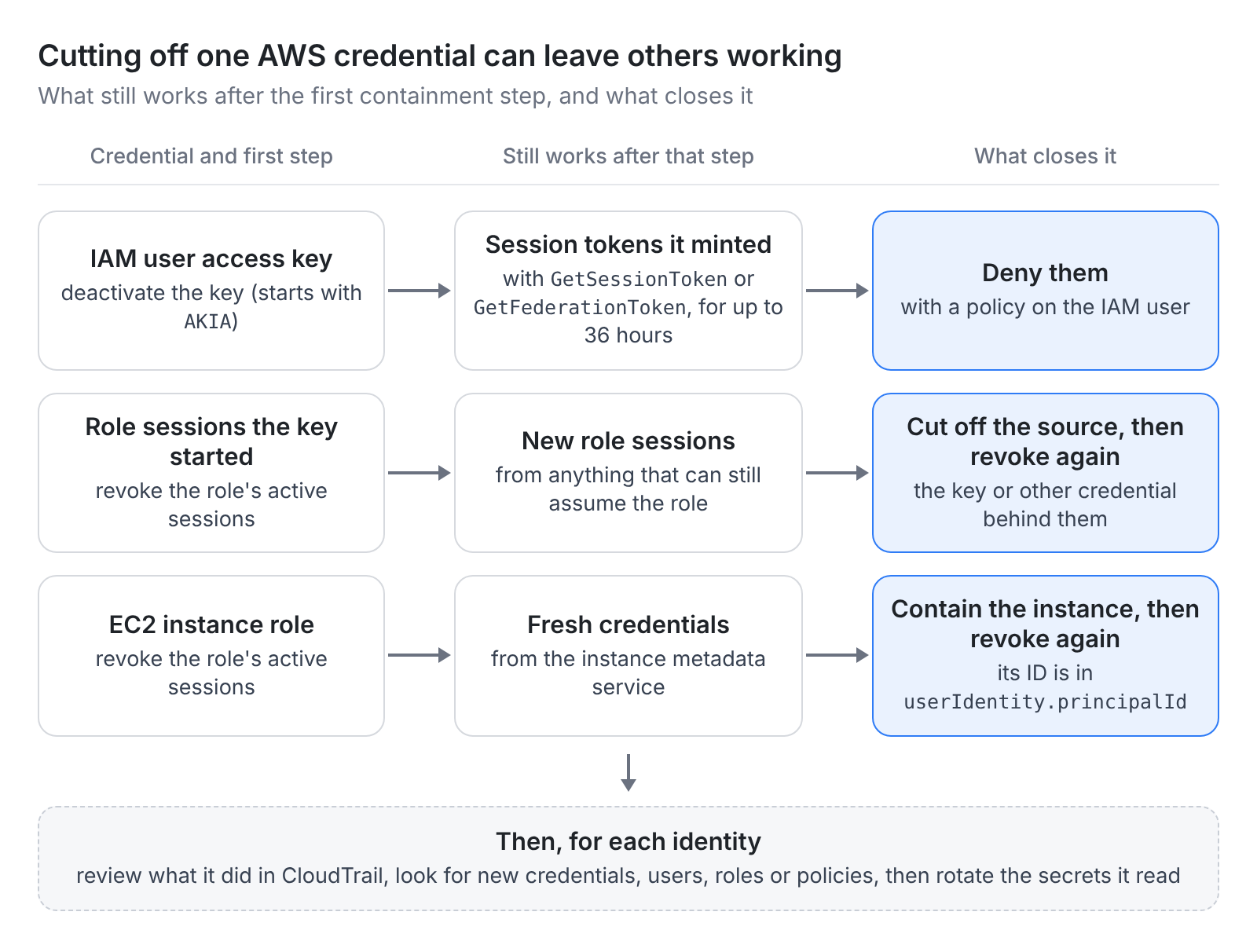
If a check finds AntiFox activity in AWS, cut off the identity first, along with any other identity used from the actor's addresses. Deactivate the IAM user's access key (the one recorded in userIdentity.accessKeyId when it starts with AKIA), or for a role, revoke its active sessions, which denies every session issued before that moment. Both steps interrupt legitimate use too: an application on the old key stops working, and valid sessions on the role have to get new credentials. Then confirm the cut-off held: a later call that succeeds from the actor's addresses, or from an address new to the identity, is a sign that another credential is still live.
A stolen key may also have been used to get temporary credentials, which AWS notes are valid until they expire. So check CloudTrail for AssumeRole, GetSessionToken and GetFederationToken calls made with the key, and revoke sessions on any role it assumed. Sessions from GetSessionToken or GetFederationToken are tied to the IAM user, and rotating its key does not invalidate them, so deny them with a policy on that user. Revoking does not block new sessions, so find where the credential was exposed and close that path before issuing a replacement. For an EC2 role, that path usually runs through the instance, whose ID appears as the session name in userIdentity.principalId. Anything that can still query the instance's metadata service can get the next credentials EC2 issues, so contain the instance as well as revoking the role's sessions.
The diagram below shows, for each kind of AWS credential involved, what still works after the first step and what closes it.
Before issuing replacements, review everything the identity did in CloudTrail, as Arctic Wolf advises, including what any temporary session it started went on to do under its own access key ID. Treat each secret it read as exposed, and change the underlying credential at its source, such as a database password or an API key. Check for logins or calls with that credential after the read, from sources the system behind it does not normally see. Where logs show S3 object activity, treat what the identity read or copied as exposed, and check whether deleted objects can be restored from earlier versions or backups. Before rotating secrets, look for changes that would outlast the key, such as CreateAccessKey, CreateUser, AttachUserPolicy or PutRolePolicy calls.
On the web server, the report's guidance is to isolate the host and preserve the web root, IIS logs, endpoint telemetry and memory before any rebuild. Remove unauthorized ASPX files and the copied configuration and log files, and check writable web directories for other shells and modified application files. Removing the files does not close the way in, and the report does not identify the vulnerability to patch. In the IIS logs, find the request that created the first shell, and fix or block that path before the server returns to service. Then rotate every credential and encryption key that sat in web.config, application settings, deployment artifacts, debug logs, environment variables or configuration backups.
Amazon points customers who suspect unauthorized activity to its guidance on potentially compromised credentials or to AWS Support. For hardening, Amazon recommends least-privilege permissions, requiring IMDSv2 on EC2 instances, keeping long-term access keys out of application configurations and turning on GuardDuty. Arctic Wolf also recommends S3 data events and versioning on sensitive buckets, Object Lock where it fits, and an alert on successful GetSecretValue calls from new infrastructure.
How Prophet AI Threat Hunter covers AntiFox
Prophet AI Threat Hunter's emerging-threat hunt for AntiFox hands suspicious leads to Prophet AI SOC Analyst for a full investigation. Each investigation returns a determination with every query and piece of evidence behind it. When an investigation confirms a threat, Prophet AI Threat Hunter scopes related activity across the connected data sources, showing when it started and how far it reached.
Our overview of AI threat hunting explains how hunts for emerging threats work. To hunt for the AntiFox AI attacks without writing the queries by hand, see how Prophet AI Threat Hunter handles emerging threats.
AntiFox is an open-source penetration testing platform that uses AI agents to automate the steps of a penetration test. BleepingComputer reports that it began as a fork of ARTEX. On November 10, 2026, Arctic Wolf Labs tied Alibaba Cloud systems hosting AntiFox to intrusions against internet-facing web applications and AWS environments. Arctic Wolf's report names no threat actor.
No AWS vulnerability has been reported. Arctic Wolf describes valid IAM user and EC2 role credentials, obtained through unknown means, being used to call AWS APIs. Amazon told BleepingComputer that AWS services were not compromised and that the research describes credentials taken from customers' compromised applications. In a separate case, an IIS web application was compromised through a vulnerability Arctic Wolf could not identify.
AntiFox began as a fork of ARTEX, BleepingComputer reports, so the two share an origin but are separate projects. ARTEX is the original project, an AI penetration testing platform that Microsoft, Google and CrowdStrike, among others, have tied to intrusions. Arctic Wolf's November 2026 report focuses on AntiFox: it does not mention ARTEX, and it names no threat actor behind the activity.
Search CloudTrail for the two source addresses Arctic Wolf published, then for the behavior: one address using several access keys or roles, and a burst of mostly denied List, Get and Describe calls across many services, from an identity that does not normally produce one. Review every call in that burst that succeeded, especially GetSecretValue. S3 object reads, copies and deletes are logged only where data events or server access logs were enabled.
Yes. Prophet AI Threat Hunter has an emerging-threat hunt for AntiFox that a team can run once or schedule. Suspicious leads go to Prophet AI SOC Analyst for a full investigation. When an investigation confirms a threat, Prophet AI Threat Hunter scopes related activity across the connected data sources, showing when it started and how far it reached.

Insights
Definitive Guide to Detection Engineering
Where detection engineering falls short, how to close those gaps, and what it looks like in an AI-enabled SOC.


As the Director of Product Marketing at Prophet Security, Ajmal drives marketing and growth strategies and helps security professionals see how AI is transforming security operations.