


Best AI SOC Tools for Alert Triage (2027): What to Look For

AI SOC tools for alert triage use AI agents to assess security alerts, and the most complete of them investigate each alert to a decision. They pull evidence from the systems an alert touches, follow what they find, and conclude whether the alert is a real threat, with the evidence attached. Triage was the first job AI SOC tools took on, and the category has since moved into threat hunting, detection engineering and response.
Many security platforms now advertise an AI agent for triage, so the label alone tells a buyer little. AI SOC tools for alert triage differ most in how much of each investigation they finish on their own and which of your data sources they reach.
They also differ in how easily an analyst can check their reasoning without redoing the work. For the triage process itself, see our complete guide to alert triage.
{{ebook-cta}}
What separates alert investigation from alert enrichment?
Enrichment attaches context to an alert, such as threat intelligence on an IP address or the owner of a host, and hands it back for an analyst to decide. Investigation goes further: it asks the follow-up questions, queries the systems that can answer them, and reaches a determination that someone can review.
A tool that enriches makes each decision faster, but the analyst still makes every decision. A tool that investigates can close routine alerts with the evidence documented and pass the rest to an analyst with the work already done.
What should AI SOC tools for alert triage do with every alert?
Eight checks show whether a tool investigates or only adds context, how fast it pays off, and how much control your team keeps.
- Depth and accuracy. Depth is how far the tool takes an investigation: whether it follows a finding into the next system or stops at the first answer. Accuracy is how often its determinations match your analysts' conclusions. Ask for the rate measured against a human analyst team, and measure it yourself on your own alerts, with malicious and benign calls counted separately, since a tool can score well overall while missing real threats.
- Adaptability to your environment. Every environment has its own normal, such as admin tools that resemble attacker tools or service accounts that sign in at odd hours. Ask how the tool learns that context, whether analysts can correct a determination and teach it in plain language, and whether you can review and test what it learns before that changes future investigations.
- A comprehensive platform. Triage is the first step of the work. Check whether the same platform also hunts, tunes and writes detections, and responds, so what triage finds reaches the rest of the SOC without someone carrying it over.
- Immediate value. The tool should work with the SIEM, EDR and identity tools you already run, without a rip and replace, and work real alerts from the first day rather than after months of tuning.
- Coverage of every alert. Low-severity alerts can carry the early signs of an intrusion, so a tool that works only high-severity alerts leaves much of the queue unexamined. Coverage also varies by alert type: some built-in triage agents cover certain alerts, such as user-reported phishing, and are adding other types in preview. Ask how much query load working every alert puts on your SIEM, and what those queries cost where they are billed.
- Reach across data sources. An EDR alert often needs identity, cloud or email evidence to resolve. Agents built into one vendor's SIEM or EDR tend to investigate within the data stored in that platform, so test what happens when the evidence sits somewhere else.
- Visible reasoning. Each determination should come with the questions the tool asked, the queries it ran and the evidence it found, so an analyst can rerun a query and check the result.
- Response limits you set. Your team should decide which actions run on their own, under what conditions, and which wait for a person.
Prophet Security: one of the first AI SOC platforms built to investigate every alert
Prophet Security launched its AI SOC Analyst in April 2024, which makes it one of the first AI SOC platforms. It was built for alert investigation from day one. Today it is part of Prophet AI, a platform spanning AI SOC Analyst, AI Threat Hunter, AI Detection Engineer and AI Watchtower.
Prophet AI investigates every alert to an evidence-backed determination across SIEM, EDR, identity, cloud and email, and shows every query behind each one.
AI SOC Analyst does the triage work. When an alert arrives, its investigation agents plan an investigation for that specific alert instead of following a fixed playbook.
They decide what to ask, query the SIEM, EDR, identity provider, cloud logs and email platform for the answers, and follow each finding to the next question. The investigation ends in a determination, with the evidence that supports it.
Every alert gets that treatment, at every severity, and the thousandth alert of the day gets the same depth as the first. Related investigations are grouped into cases, alongside the case management tool your team already runs.
An analyst can see every question the agents asked, every query they ran and every piece of evidence they collected. They can also copy any query and run it in their own tools. In evaluations, analysts tend to check the queries before they trust the determinations, and the full record lets them do that.
When an alert turns out to be malicious, AI SOC Analyst responds through Agent Actions. Your team decides which actions run on their own, under what conditions, and which need a person to approve them.
Where no action is set up, Prophet AI suggests one your team can take with one click. Agent Actions can also ask the affected user questions over Slack or Microsoft Teams and add the answer to the investigation.
The determinations also feed the rest of the platform. AI Detection Engineer builds and tunes detections from what your investigations, hunts and coverage gaps reveal, and tests each change against your own history before it applies.
AI Threat Hunter runs hunts on its own, on the schedule your team sets and automatically when a severe new threat appears. AI Watchtower is an optional layer of Prophet Security's human experts who work behind the AI around the clock. They review the determinations it marks malicious or cannot resolve, and send validated escalations.
At a Fortune 500 manufacturer, Prophet AI reached 98.5% agreement with the human analyst team across 12,000 investigations and cut typical investigation time from 30 to 60 minutes to under 5. Prophet Security was also named to Rising in Cyber 2026, voted by 150 CISOs and security leaders, and to the Fortune Cyber 60 for the second year in a row.
Customer data never trains the models, deployments are single-tenant, the data plane can run in your own VPC, and LLM providers retain none of your data. Prophet Security holds SOC 2 Type II, ISO/IEC 27001:2022 and ISO/IEC 42001:2023 certifications.
AI SOC tools for alert triage that launched in 2026
Several companies brought AI SOC products to market in 2026. We list three of them for readers who want to see what is new in AI SOC, and the list does not rank them.
Kai came out of stealth in March with a platform whose autonomous agents analyze security telemetry, investigate related signals and trigger response actions. Mave came out of stealth in October with a generally available agentic system that investigates alerts by pulling together the security tools a company already runs. Zscaler launched Zscaler Agentic SOC in September, with AI agents that investigate alerts using the traffic data Zscaler already inspects, alongside data from third-party tools.
How do you test AI SOC tools for alert triage before you buy?
Run the tool against alerts your team has already resolved. Pick a recent week of real alerts across your sources, let the tool investigate them, and compare its determinations and evidence with what your analysts concluded. Where the two disagree, check the evidence before you score the call, since an alert your team never fully investigated can still turn out to be real.
Three questions test how well the tool triages. Did it investigate every alert, or only the ones that were easy to resolve? Can an analyst follow its reasoning to each determination without redoing the work? How often did its determinations match your analysts' conclusions, for both malicious and benign calls?
A true positive closed as benign usually costs more than an extra escalation, so score the benign calls as closely as the malicious ones. A week of routine alerts may hold few true positives, so add known ones, such as alerts from a recent incident or red-team exercise.
Also ask which parts of the demo are generally available for your license and region. For the capabilities the category has in common, see our guide to the best AI SOC platforms, and for the role itself, our practitioner's guide to the AI SOC analyst. To see an investigation on alerts like yours, look at Prophet AI SOC Analyst.
The best AI SOC tools for alert triage investigate every alert to an evidence-backed determination, reach across SIEM, EDR, identity, cloud and email, and show every query behind each conclusion. Prophet AI, which Prophet Security launched in 2024, works this way and adds response through Agent Actions that your team controls. Whatever you shortlist, test it on alerts your team has already resolved and check its benign calls closely.
Alert triage investigates an alert to a determination: it gathers and weighs evidence across systems and decides whether the alert is a real threat. Alert enrichment only adds context, such as threat intelligence or asset details, then hands the alert back for a person to judge. Automated triage reduces the number of decisions analysts make, while enrichment makes each remaining decision faster.
They can be, when most of your evidence is stored in that vendor's platform. However, that’s rarely the case due to SIEM storage costs. Agents built into one SIEM or EDR tend to investigate within the data stored in that platform, and some of their features are still in preview. If your alerts regularly need identity, cloud or email evidence from other vendors, test how far one investigation carries before the agent hands the work back to an analyst.
Compare its determinations with your own analysts' conclusions on alerts you have already resolved, and check the evidence behind each one as well as the score. Score the benign calls closely, since a true positive closed as benign is usually the costliest mistake. As a reference point, Prophet AI reached 98.5% agreement with a Fortune 500 manufacturer's human analyst team across 12,000 investigations.
Yes, when the tool connects to those sources. A capable AI SOC tool investigates across the SIEM, EDR, identity provider, cloud logs and email platform inside one investigation. Agents built around one vendor's endpoint or SIEM data tend to be strongest on that data. During an evaluation, check which of your sources the tool reaches and how it handles an alert whose evidence spans several of them.
No. Customer data never trains Prophet AI's models, deployments are single-tenant, the data plane can run in your own VPC, and LLM providers retain none of your data. Every investigation records each query and piece of evidence behind its determination, so the work can be audited. Confirm the deployment and data-handling details for your environment during evaluation.
Insights
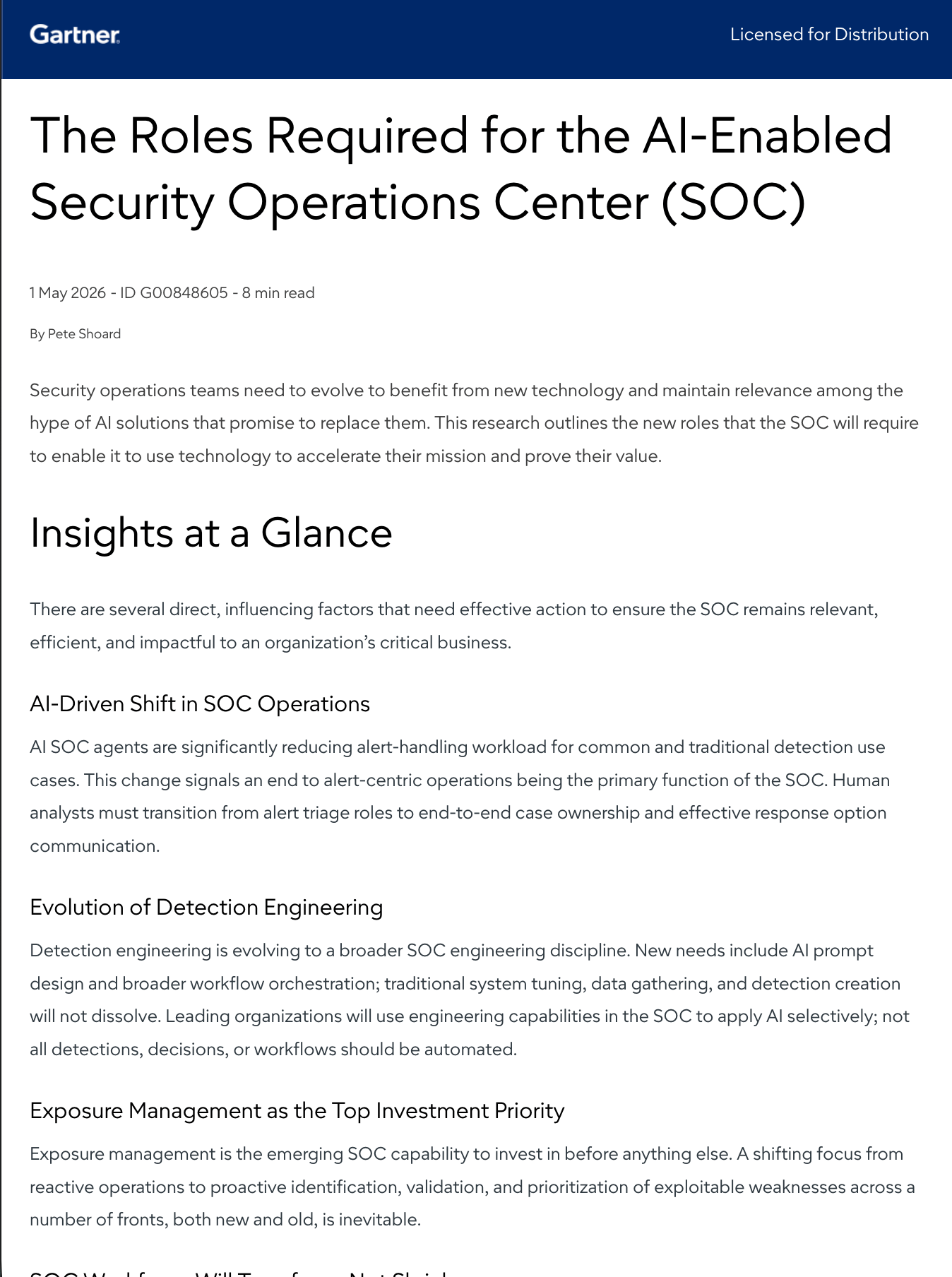
The Roles Your AI-Enabled SOC Will Need
Gartner research on how SOC roles shift as AI SOC agents reduce alert-handling work

As the Director of Product Marketing at Prophet Security, Ajmal drives marketing and growth strategies and helps security professionals see how AI is transforming security operations.