


Will AI Replace the SOC Team? What Gartner Says About AI-Enabled SOC Roles

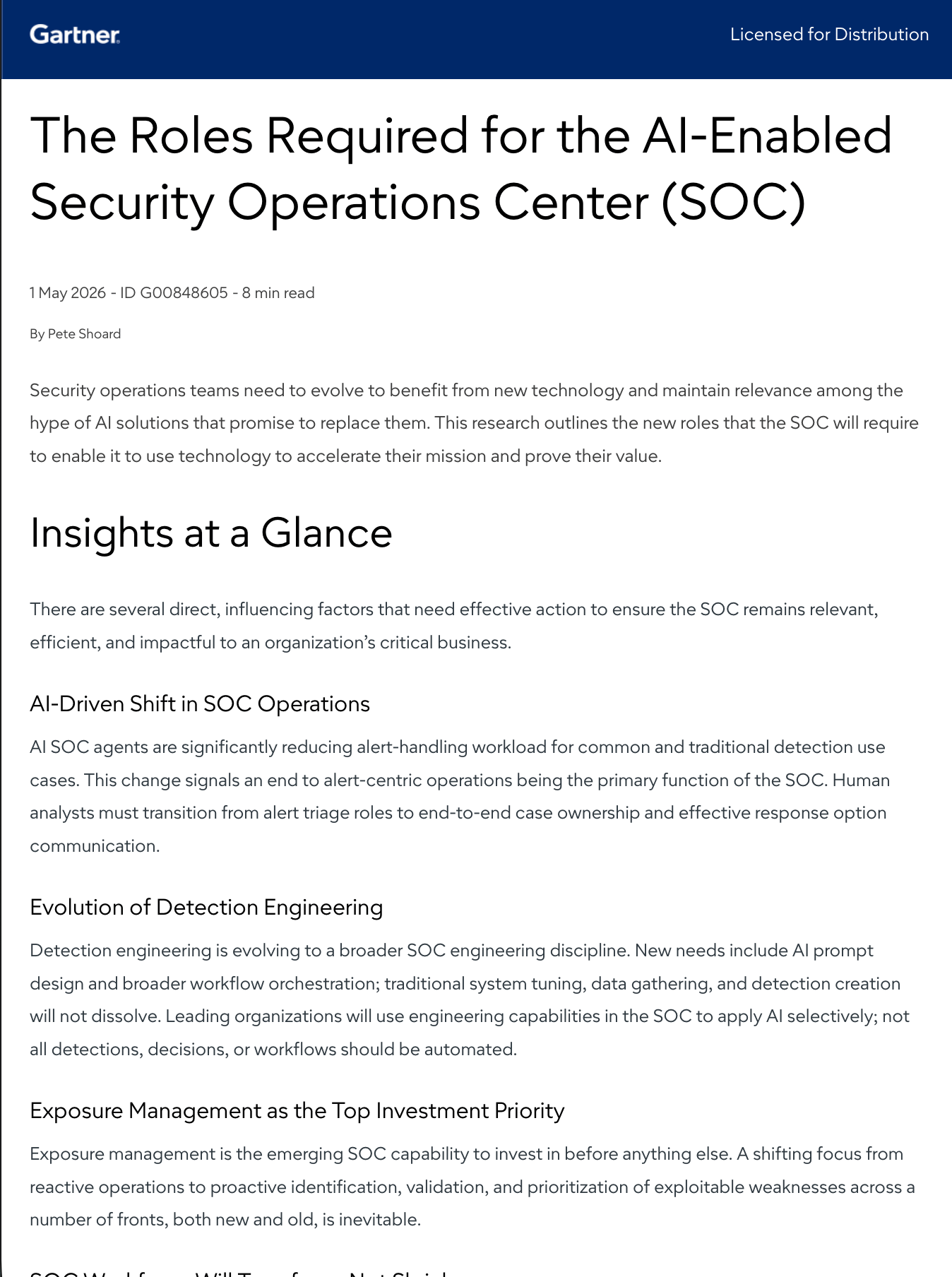
Many conversations we have about AI in the SOC eventually bring up the same question: what happens to my team? A new Gartner report, The Roles Required for the AI-Enabled Security Operations Center (SOC) by Pete Shoard, offers one of the clearest answers we've seen. We're making it available to download, and below we share why it resonates so strongly with what we see across our customers.
{{ebook-cta}}
AI is now the answer to alert overload
The report starts from a premise SOC teams know too well: alert-centric operations can't scale. Gartner finds that AI SOC agents are already significantly reducing alert-handling workload for common and traditional detection use cases, and it describes this as the end of alert processing as the SOC's primary function.
The framing is accurate. Alert triage becomes a machine problem, and case decision making becomes a human responsibility. Analysts shift from hunting through queues for suspicious activity to confirming AI-identified outcomes and owning cases end to end.
This is the first problem solved by Prophet AI. When AI handles investigation of every alert, analysts stop drowning in volume and start applying judgment where it is really required. What to do with that extra capacity (hah! Have you ever thought we would be discussing “extra capacity” in the SOC context?) is a core question of how SOCs will evolve, and it's where the report gets most interesting.
Detection engineering moves to the center
One of the report's boldest predictions is that by 2028, security operations teams will have 50% more engineers than analysts. Gartner describes detection engineering expanding into a broader SOC engineering discipline. Rule writing and tuning remain, joined by prompt design, workflow testing, AI output validation, and software engineering practices like versioning, testing, and rollback.
We agree, and it's why we built Prophet AI Detection Engineer. Once alert handling is largely offloaded to AI, threat hunting and detection engineering become the new focus for analysts. Those are the activities that improve what the SOC can see and catch, so we extended our platform to support those processes directly, not just the investigation of alerts.
Operational feedback management is already a real job
It was interesting to see Pete list "operational feedback management" among the responsibilities of the future detection engineer, alongside a broader reorganization of SOC roles. The report notes that analysts will increasingly provide feedback to improve AI accuracy, and that AI-assembled case files still need meaningful human validation to build confidence.
This is already happening for some of our customers. We've seen analysts move from alert handling to curating the guidance they give the AI platform, making sure it's accurate and as useful as possible for contextualizing investigations. That work directly raises investigation accuracy and outcome quality.
Measuring different things
We've been writing a lot about SOC metrics here in the blog. Gartner also points to the need to reposition the SOC KPIs. They should move from alert volume, closure rates and MTTD to focus on case accuracy, cycle time, and decision confidence, metrics that are focused on the outcome quality.
Exposure management gets some love
Gartner names exposure management as a primary SOC capability. It calls for continuous threat exposure management (CTEM) as a standing SOC function rather than an annual or quarterly exercise. It also predicts that by 2030, SOCs will be largely offensively driven, testing their own business the way an attacker would.
Many security teams have wanted to do exactly this for years. They've wanted to run more offensive exercises, validate exposures continuously, and get ahead of attackers instead of reacting. Alert overload never left room for it.
With an AI SOC handling alerts, that's changing. We're seeing customer teams become more aggressive in continuously testing and assessing their environments. That shift aligns closely with the proactive, exposure-first SOC the report describes.
So, what about my team?
This is the question we hear most often when discussing AI SOC adoption, and the report answers it plainly: "The SOC will not shrink by 2030." Roles will change radically, and the workforce gets redirected from processing alert volume toward detection engineering, threat expertise, offensive testing, and exposure management.
AI gives teams time back for the work that was being neglected. Threat hunting is a good example. Our recent State of AI in Security Operations report found that teams that hunt weekly find 3x more threats than teams that hunt less than monthly. Most teams know regular hunting pays off. Few have had the capacity to do it consistently. Making that possible is a big part of what we're enabling for our customers.
Read the full report
The AI-enabled SOC is moving people to the work that matters most: owning cases, engineering detections, feeding back into the AI, hunting, and testing the environment before attackers do. Gartner's report lays out the roles that make this possible and what SOC leaders should start doing today.
Download The Roles Required for the AI-Enabled Security Operations Center (SOC) to see how SOCs are evolving and the role AI plays in that evolution.

Insights
The Roles Your AI-Enabled SOC Will Need
Gartner research on how SOC roles shift as AI SOC agents reduce alert-handling work

As Principal Product Manager at Prophet Security, Augusto applies his hands-on experience and critical thinking to help push forward the new capabilities of Prophet AI SOC platform