


AI SOC Tools to Reduce False Positives and Alert Fatigue (2027)

AI SOC tools reduce the false positives that reach your analysts in two main ways. They investigate alerts to a determination, so an analyst does not have to confirm by hand that a benign alert is benign.
They also tune the detections that produce the noise, so fewer low-value alerts fire at all. Before you compare AI SOC tools to reduce false positives, it helps to know which of the two each one relies on, since each leaves a different gap.
Other levers cut noise too. Risk-based alerting in a SIEM rolls weak signals up into fewer, scored alerts, and fixing the data quality problems that make detections misfire removes noise at its origin. XDR and SIEM platforms can also group related alerts into a single incident, which shortens the queue an analyst works, though the individual alerts still fire.
Alert fatigue also has causes beyond false positives, including volume, missing context that requires context switching between tools, and after-hours load. Our guide on how to reduce alert fatigue provides practical steps to help teams combat alert fatigue.
{{ebook-cta}}
How does investigating every alert cut the cost of false positives?
When an AI SOC tool investigates, it works every alert, regardless of severity, the way an analyst would. It pulls context from sources such as the SIEM, EDR, identity provider, cloud logs and email platform, follows what it finds, and reaches a determination with the evidence attached. The benign alert still fired, but no analyst had to work it to find that out.
False positives still fire at the same rate, but the tool works them instead of your analysts. That includes alerts from rules a team cannot safely suppress, since every one still gets examined.
Its value depends on the tool getting benign calls right, so the accuracy of its benign determinations is the first number to test. The second is how many alerts it leaves for an analyst to resolve.
How does detection tuning reduce false positives at the source?
Detection tuning works on the volume itself. It finds the rules that produce the most low-value alerts, then refines or suppresses them so fewer of those alerts fire or reach an analyst. Our guide to alert tuning best practices covers the manual version of this work.
Suppression carries the main risk. A noisy rule can also be the only detection for a technique, and silencing it can leave that technique with no coverage at all.
Before suppressing a rule, a team needs to see which MITRE ATT&CK techniques it covers and how the change would have played out against past alerts. False positives often come from specific users or IP addresses, such as a service account or a vulnerability scanner, and excluding just those keeps the rule covering the rest. Exclusions carry their own risk, since attackers can act through an excluded account or host, or name or place their tools to match an excluded path or process name.
Why do teams need both approaches?
Tuning lowers the count, and investigation handles whatever still fires, including the rules a team cannot safely suppress. Many alerts closed as false positives are benign true positives: real, authorized activity that a rule may be unable to tell apart from an attacker doing the same thing.
A team that only tunes risks suppressing a rule that was its last line of defense. A team that only investigates keeps spending time and money working noise it could have removed.
Prophet Security: investigation and detection tuning in one AI SOC platform
Prophet Security launched its AI SOC Analyst in April 2024, making it one of the first AI SOC platforms. Today Prophet AI runs both approaches in one platform: AI SOC Analyst investigates every alert, and AI Detection Engineer builds and tunes the detections behind those alerts, using what the investigations found.
Prophet AI reduces false positives with both approaches at once: it investigates every alert to an evidence-backed determination, and it builds and tunes the detections that produce the noise. Prophet AI also adapts to your environment. Your team can give it feedback and guidance in plain language, on a single investigation or across all of them, such as a note that a pen test is under way, so investigations and tuning follow how your organization operates.
On the investigation side, AI SOC Analyst's agents plan each investigation for the alert in front of them. They query your SIEM, EDR, identity, cloud and email sources, follow each finding, and reach a determination with the evidence attached, at every severity. Every question, query and piece of evidence is visible, so an analyst can rerun a query and check a benign call.
On the detection side, AI Detection Engineer keeps a live MITRE ATT&CK coverage map built from your own investigations. The map separates techniques you have observed, techniques a detection covers, and techniques nothing covers yet, so you can see what a suppression would cost before you make it.
AI Detection Engineer then recommends tuning and suppressions drawn from real investigations, writes new detections in your SIEM's own query language, and backtests each change against your history. Every change arrives as a reviewable, version-controlled proposal with its rationale, evidence and backtest results, and your team decides how much it applies on its own.
Investigations show which rules produce noise, tuning reduces that noise, and the alerts that still fire get the same full investigation. AI Threat Hunter adds hunts, run on a schedule or automatically when a severe new threat appears, for activity no detection catches yet.
At a Fortune 500 manufacturer, Prophet AI reached 98.5% agreement with the human analyst team across 12,000 investigations and cut typical investigation time from 30 to 60 minutes to under 5. Prophet Security was named to Rising in Cyber 2026, voted on by more than 150 CISOs and security leaders, and to the Fortune Cyber 60 for the second year in a row. Prophet AI is rated 4.9 out of 5 on Gartner Peer Insights. Prophet AI works with the SIEM, EDR and identity tools you already run, without a rip and replace. Customer data never trains the models, and deployments are single-tenant, with the option to run the data plane in your own VPC.
AI SOC tools to reduce false positives that launched in 2026
Several companies brought AI SOC products to market in 2026. We name them for readers who want to see what is new in AI SOC, and naming them here does not rank them.
Kai came out of stealth in March; its autonomous agents analyze security telemetry, investigate related signals and trigger response actions. Mave came out of stealth in October with an agentic system built to pull together the security tools a company already runs. Zscaler Agentic SOC launched in September, with AI agents that investigate alerts by correlating the traffic data Zscaler already inspects with third-party data.
Where do SIEM and SOAR fit?
AI SOC tools work alongside a SIEM, since many detections fire there and it holds the logs an investigation queries. SOAR is a different case. A SOAR platform runs playbooks a team has to build and maintain for each alert type. An AI SOC platform that investigates and responds plans each investigation itself and carries out the response actions your team has approved, so in security operations it can take over the work SOAR playbooks do. Teams that also use SOAR for wider IT or business workflows often keep it for that work.
Detection tuning changes the rules and exclusions in the SIEM and in the other tools that raise alerts. An AI SOC analyst works the alerts that the SIEM and other tools produce, then takes the response actions your team has approved or hands its determinations to a ticketing system or a person.
Map any tool to the layer it touches before you compare claims. For how investigation fits the wider triage workflow, see our alert triage guide.
Where should you start if false positives are your main problem?
Start with where the noise comes from. Rank your rules by alert volume and by the share closed as benign over the past 90 days, using the close reasons in your SIEM or case management tool. Spot-check a sample of closed alerts first, since a close reason left at its default or applied in bulk can skew the ranking.
If a small number of rules produce most of it, tuning those rules will cut the most noise soonest. If the noise is spread across many rules you cannot safely suppress, an AI SOC analyst that investigates every alert takes most of that work off your analysts.
Either way, test AI SOC tools to reduce false positives on your own alerts.
Give the tool a week of alerts your team has already resolved, with their close reasons hidden from it, compare its determinations with your team's, and look hardest at what it called benign. Include alerts from confirmed incidents still within your log retention or from an attack simulation, so the test can show what the tool misses. For the wider category, see the capabilities AI SOC platforms share and our practitioner's guide to the AI SOC analyst.
False-positive reduction means fewer benign events flagged as threats, or each one confirmed quickly. Alert fatigue is the human result of too many alerts of any kind, true or false, arriving faster than a team can work them. Cutting false positives helps with fatigue, but fatigue also comes from volume, missing context and after-hours load, so the two are related but distinct goals.
First, they investigate alerts to a determination, so an analyst does not have to confirm noise by hand. Second, they tune detections at the source, so fewer low-value alerts fire. Many tools rely on one of the two. Prophet AI does both, pairing AI SOC Analyst's investigations with AI Detection Engineer's tuning: tuning lowers the volume, and investigation handles whatever still fires.
Not your SIEM. Many detections fire in the SIEM, and an AI SOC tool investigates the alerts the SIEM and other security tools produce, while detection tuning refines the rules that raise those alerts and the suppressions applied to them. For security operations, an AI SOC platform that investigates and responds can take over the work SOAR playbooks do, carrying out the actions your team has approved without a playbook built for each alert type. Teams that use SOAR for wider IT or business workflows often keep it for that work.
Treat it as a claim to test on your own data. Accuracy depends on your alert mix, detection quality and environment, and many published figures come from the vendor's own telemetry. Compare the tool's determinations with your team's on alerts you have already resolved, including some from recent confirmed incidents, and score its benign calls closely. Prophet AI's reference point is 98.5% agreement with a Fortune 500 manufacturer's analysts across 12,000 investigations.
It depends on where your noise comes from and what you already run. An agent built into one SIEM or EDR works best on the data that platform collects, and some of these features are still in preview. A dedicated AI SOC platform such as Prophet AI investigates across the security tools you already run and pairs investigation with detection tuning, which suits SOCs that run tools from several vendors.
Find out where the noise comes from first. If a handful of rules produce most of it, tuning those rules cuts noise fastest. If the noise is spread across many rules you cannot safely suppress, an AI SOC tool that investigates every alert cuts the analyst time each one costs. Either way, test any tool against alerts your team has already resolved before you commit.
Insights
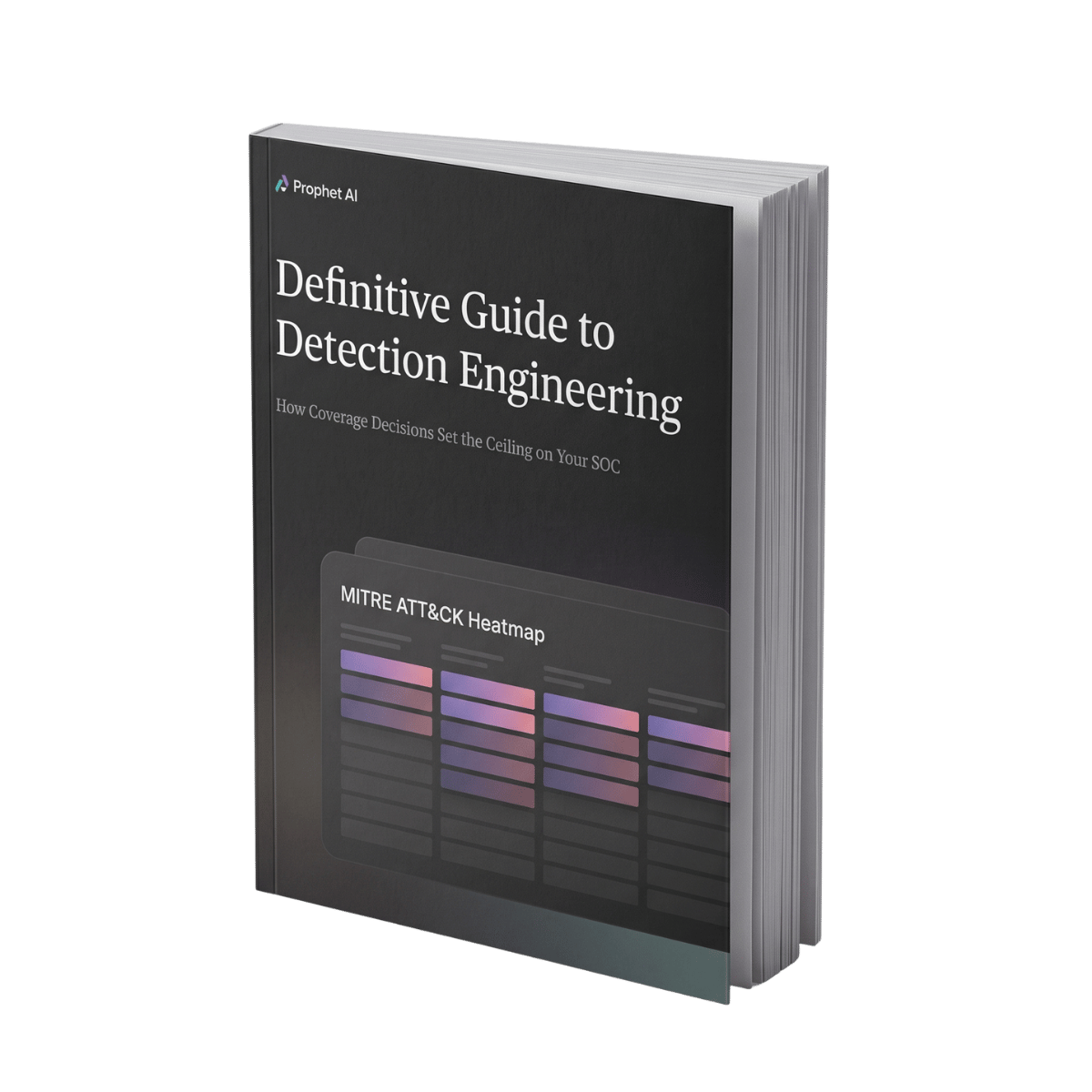
Definitive Guide to Detection Engineering
Where detection engineering falls short, how to close those gaps, and what it looks like in an AI-enabled SOC.

As the Director of Product Marketing at Prophet Security, Ajmal drives marketing and growth strategies and helps security professionals see how AI is transforming security operations.