


AI SOC Platforms for Lean Security Teams (2027)

A lean security team is one whose workload has outgrown its hiring plan. That can describe a team of any size. AI SOC platforms for lean security teams take on the investigation work (and, in broader platforms, the hunting and detection work) that the environment generates beyond what the team can hire for, while the team decides what the AI does on its own.
The workload grows mostly for reasons outside a team's control. Each newly disclosed vulnerability raises the question of whether the organization is exposed, and answering whether it was already exploited in the organization takes a hunt.
Each new detection written in response adds alerts to investigate. Hiring seldom keeps pace with that growth, so the question for a lean team is how to add capacity across investigation, hunting and detection engineering.
{{ebook-cta}}
What does an AI SOC change for a lean security team?
A full investigation by hand takes long enough that an experienced analyst can work 20 to 30 alerts in a shift. Once alerts reach the hundreds a day, some go unexamined. With an AI SOC for lean security teams, every alert from connected tools can be investigated around the clock: routine alerts close with the evidence documented, and the ones it judges malicious or cannot resolve reach an analyst with the investigation already done.
Analysts then spend their time on work that needs a person: the investigations that call for judgment, response, and the hunting and detection work that used to wait. They can also learn from the AI's documented investigations. At Cabinetworks, an intern used Prophet AI to learn investigation methodology and became a senior-level analyst within a year.
What should a lean team look for in an AI SOC platform?
A lean team has the least time to supervise a tool that needs constant correction, so the evaluation bar should be high.
- Accuracy and depth of investigation. Each alert should get the questions, queries and evidence a senior analyst would gather, and the determinations should hold up when your team checks them. Ask each vendor for the rate at which the platform's determinations agree with human analysts, and how that rate is measured.
- Adaptability. The platform should take guidance in plain language and learn from analyst feedback, so your team can correct a mistake once and the platform applies the fix to similar later investigations. Without feedback learning, a lean team spends the hours the platform saved on fixing the same mistakes.
- A comprehensive platform. Investigation is one part of the work. Check whether the platform's agents also hunt, tune and write detections, and respond, and whether what one function finds reaches the others. With a separate tool for each, the team carries findings between them by hand.
- Immediate value. The platform should work with the SIEM, EDR and identity tools you already run, without a rip and replace, and investigate real alerts from the first day. A long setup period before it pays off costs a lean team the time it was bought to save.
- Transparency. You need to check the AI's work without redoing it. Every question, query and piece of evidence behind a determination should be visible, so an analyst can spot-check an investigation quickly.
- Coverage. The platform should investigate every alert you send it, at every severity and including your custom detections, across your SIEM, EDR, identity, cloud and email tools, whichever vendors supply them. Agents built into one vendor's platform tend to work best on that vendor's data.
- Control over response. Your team decides which actions run on their own, under what conditions, and which wait for approval, with a record of every action taken.
- Data handling. Check whether customer data trains the vendor's models, whether deployments are single-tenant, and whether the platform can run in your own cloud.
Prophet Security: one of the first AI SOC platforms, now covering investigation, hunting and detection
Prophet Security launched its AI SOC Analyst in April 2024, making it one of the first AI SOC platforms. Today Prophet AI covers investigation and response, threat hunting, and detection engineering with four products: AI SOC Analyst, AI Threat Hunter, AI Detection Engineer and AI Watchtower.
Prophet AI gives a lean security team the capacity to investigate every alert, hunt for emerging threats and tune detections, while the team decides what runs on its own.
AI SOC Analyst investigates every alert, at every severity, around the clock. Its agents plan each investigation for the alert at hand, query your SIEM, EDR, identity, cloud and email sources, follow each finding, and reach a determination with the evidence attached. Every question and query is visible, and an analyst can copy a query and run it in their own tools.
For response, your team sets up Agent Actions ahead of time: which actions run on their own, under what conditions, and which need someone to approve them. Where no action is set up, Prophet AI suggests one the team can take with one click. Agent Actions can also ask the affected user questions over Slack or Microsoft Teams and feed the answer into the investigation.
AI Threat Hunter runs hunts on its own, on the schedule your team sets and automatically when a severe new threat appears. A hunt for a severe newly disclosed threat does not wait until someone has time to run it. AI Detection Engineer builds and tunes detections from what your investigations, hunts and coverage gaps reveal, and backtests each change against your own history before it applies.
For teams that want people working alongside the AI, AI Watchtower is an optional layer of Prophet Security experts who work around the clock. They review the determinations the AI marks malicious or cannot resolve, send validated escalations, and, when a customer prefers, carry out containment on its behalf with a rollback plan and a full record.
At a Fortune 500 manufacturer, Prophet AI reached 98.5% agreement with the human analyst team across 12,000 investigations and cut typical investigation time from 30 to 60 minutes to under 5. Prophet Security was also named to Rising in Cyber 2026, voted by 150 CISOs and security leaders, and to the 2026-27 Fortune Cyber 60. Customers rate Prophet AI 4.9 out of 5 on Gartner Peer Insights.
Prophet AI works with the SIEM, EDR and identity tools you already run. Customer data never trains the models, deployments are single-tenant, and the data plane can run in your own VPC.
Should a lean team choose an AI SOC or an MDR?
An MDR is the alternative many lean teams weigh. It adds people outside your team, and for some organizations that is the right call.
The trade-offs are depth of coverage, transparency, speed and where the work is done. Some MDR services cover only high- and medium-severity incidents, and some will not cover the custom detections your team built. MDR analysts also often close alerts without enough reasoning for your team to judge the call, and escalations can arrive hours after the alert fired. Because an MDR investigates outside your team, your analysts see the verdicts but may not learn from the work behind them.
An AI SOC platform keeps the investigation in-house, can make it inspectable, and can apply it to every alert. The two can also work together, with the AI investigating what the MDR escalates and the alerts it does not cover. In side-by-side runs with an MDR, Prophet AI often escalates a real threat hours before the MDR does, including alerts the EDR vendor's own MDR service was monitoring. For more depth, see what the move from MDR to an AI SOC looks like and MDR vs. an agentic AI SOC analyst.
AI SOC platforms for lean security teams that launched in 2026
Several companies brought AI SOC products to market this year. We list them for readers who want to see what is new, and listing them does not rank them.
Kai came out of stealth in March with autonomous agents that analyze security telemetry, investigate related signals and trigger response actions. Mave came out of stealth in October; it offers an agentic system that pulls together the security tools a company already runs. Zscaler launched Zscaler Agentic SOC in September, with AI agents that investigate alerts using the traffic data Zscaler already inspects, along with third-party data.
How can a lean team evaluate an AI SOC without a long proof of value?
Point the platform at a week of real alerts, plus a few simulated attacks on a test host so it faces known true positives. Pick attacks your connected tools alert on, and tell anyone else who monitors those tools, such as an MDR, before you run them. Then check three things.
Did it investigate every alert, or only the convenient ones? Can an analyst follow its reasoning to each determination without redoing the work? Would you have trusted its overnight closes?
Look hardest at the alerts it called benign, since a missed true positive usually costs more than an extra escalation. When you compare AI SOC platforms for lean security teams, the ones that show their work make this test fast. To see how an investigation looks in practice, start with Prophet AI SOC Analyst.
An AI SOC platform for lean security teams uses AI agents to take on the security operations work a team's environment generates beyond what the team can hire for. It investigates alerts with documented evidence and, depending on the platform, runs scheduled hunts and tunes detections, while the team decides which actions run on their own. Lean describes workload relative to staff, so it applies to teams of any size.
It depends on whether you want to add outside people or keep investigation in-house and inspectable. Some MDR services cover only high- and medium-severity incidents, and many show little of their reasoning. An AI SOC platform can investigate every alert with a trail your team can review. The two can also work together, with the AI investigating what the MDR escalates. Compare depth of investigation, transparency and speed of escalation as well as price.
No. An AI SOC platform takes routine alert investigation off analysts' plates so they can spend their time on the investigations that need judgment, on response, and on hunting and detection work that used to wait. People still decide what the AI does on its own, review its determinations and handle the cases that need a human, so their time moves from working a queue to work that needs a person.
Sometimes, if most of your data sits inside that platform and the features you need are generally available rather than in preview. Built-in agents are convenient for teams standardized on one vendor. Test how much of an investigation completes on its own across all your sources, including the ones that vendor does not supply, before counting on it for overnight coverage.
Start with the highest-volume, most repetitive investigations: the noisy detections and routine triage that take hours and rarely change the outcome. Handing those off frees time for the investigations that need judgment and for response. False-positive reduction is another early gain, because it shrinks the queue the team has to look at, and detection tuning can follow once the investigations show which rules produce noise.
Run it against a week of your real alert queue, plus a few simulated attacks on a test host so it faces known true positives, and check three things. Did it investigate every alert or only the convenient ones? Can you follow its reasoning to each determination without redoing the work? Would you have trusted its overnight closes? Look hardest at the alerts it called benign, since a missed true positive usually costs more than an extra escalation.

Insights
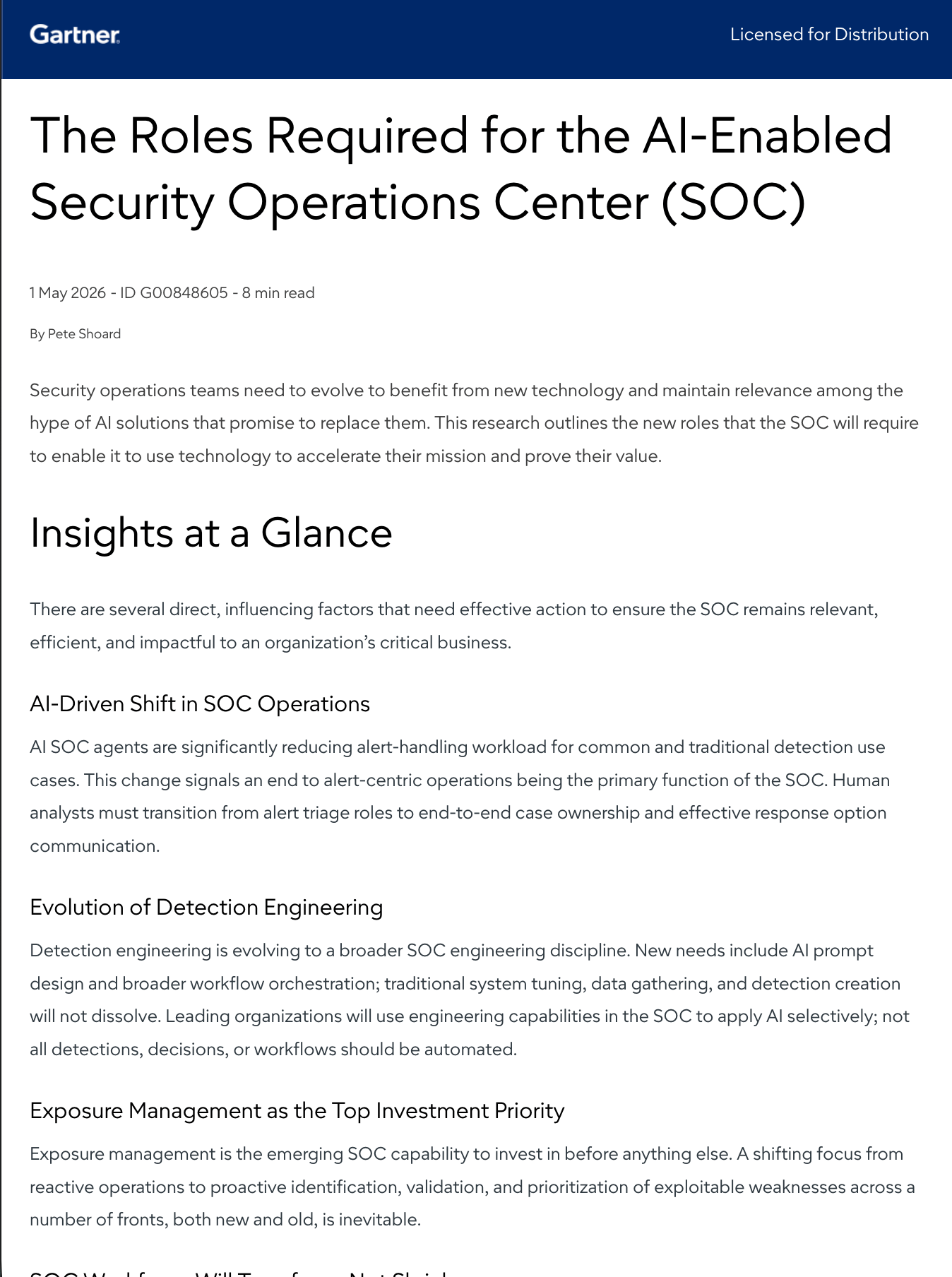
The Roles Your AI-Enabled SOC Will Need
Gartner research on how SOC roles shift as AI SOC agents reduce alert-handling work

As the Director of Product Marketing at Prophet Security, Ajmal drives marketing and growth strategies and helps security professionals see how AI is transforming security operations.